


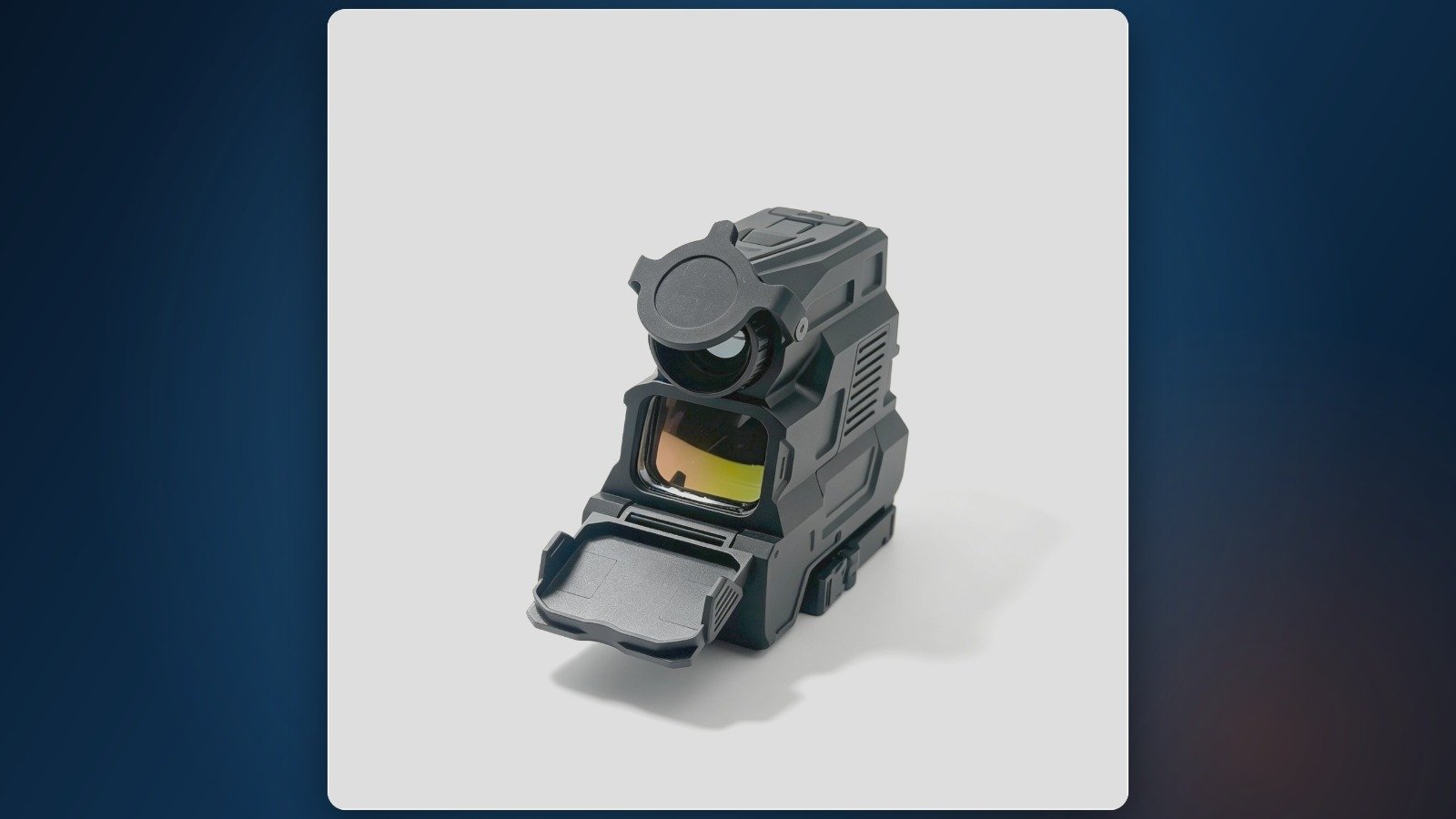
RDTIFS640 Red-dot Thermal Imaging Fusion Sight: Where Infrared Meets the Red Dot
A red-dot sight solved close-quarters aiming by removing the need to line up two surfaces. It did not solve the dark. For that, shooters have carried a separate night-vision or thermal device, and with it a second set of problems: another zero, another battery, another item of kit to mount, remove and keep track of.
The RDTIFS640 Red-dot Thermal Imaging Fusion Sight takes the opposite route. Instead of adding a second sight, it puts an uncooled infrared thermal imager and a conventional 1× red dot into the same optic, on the same sight line, so the shooter aims the same way with the lights on and with the lights off. This article looks at how that fusion actually works, and what changes in the field once it does.
Two channels, one sight line
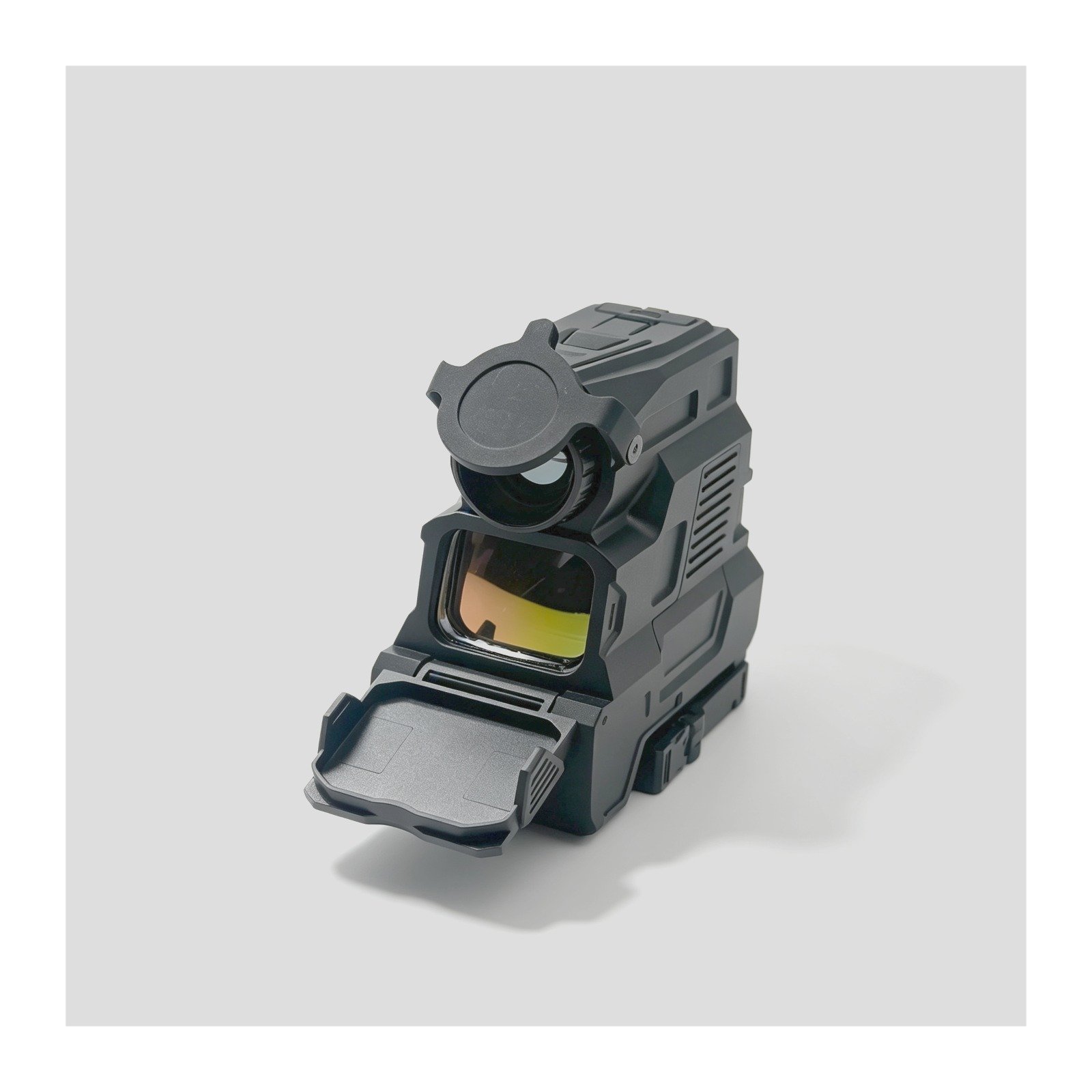
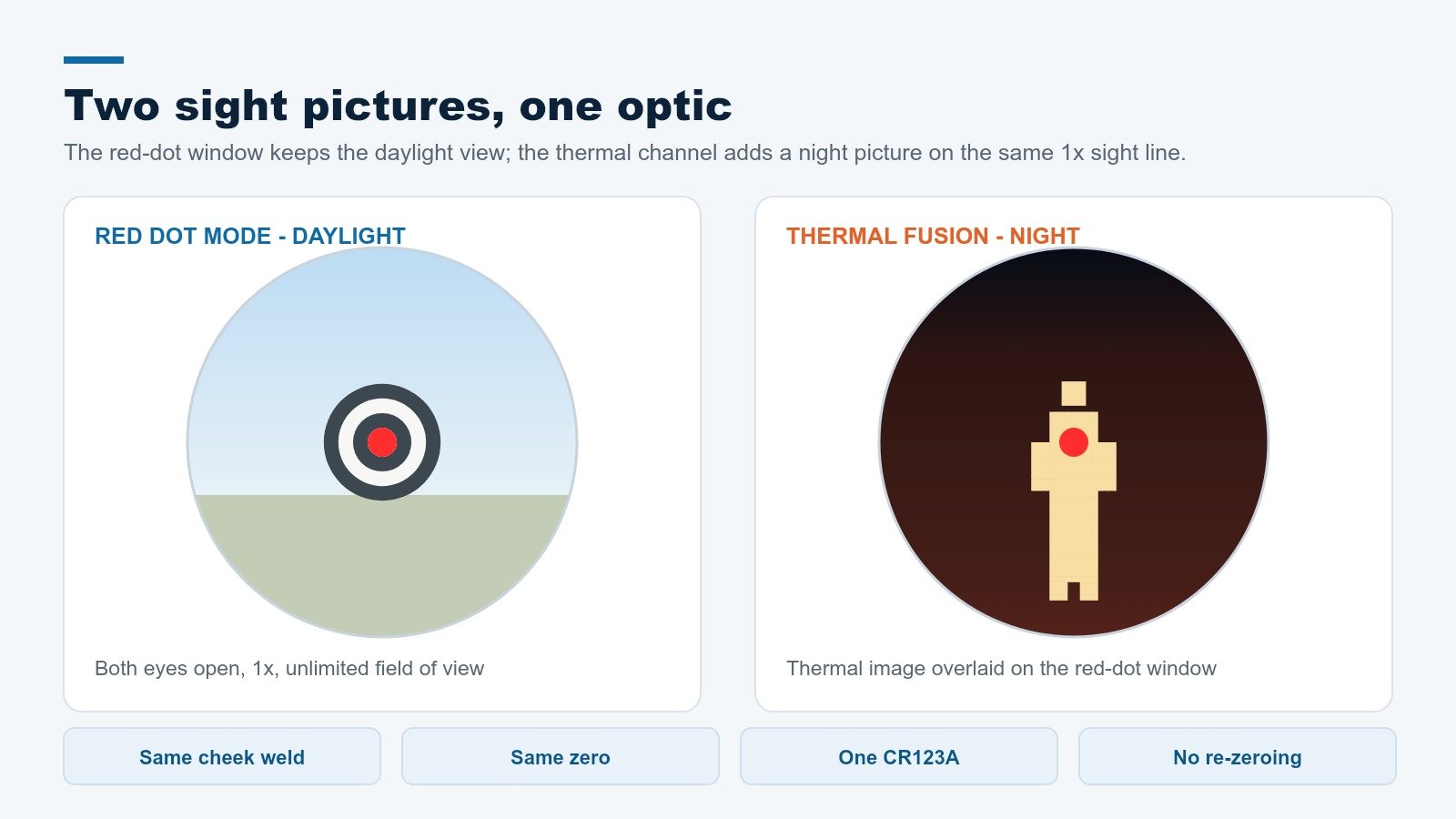
Fusion in this sight is not a software trick, and it is not a thermal imager bolted to the side of a red dot. The RDTIFS640 has a single 1× optical window. A red-dot reticle is projected into that window for daylight and close-range work. Above it sits the infrared objective, and the thermal image is presented on a 1024 × 768 OLED display behind the same viewing window.
Because both aiming references occupy one window at one magnification, the shooter keeps the same cheek weld, the same head position and the same zero whether the thermal channel is on or off. That is the practical difference between a fusion sight and two separate optics: there is nothing to re-zero, and nothing to re-learn when the light drops.
What the infrared channel adds
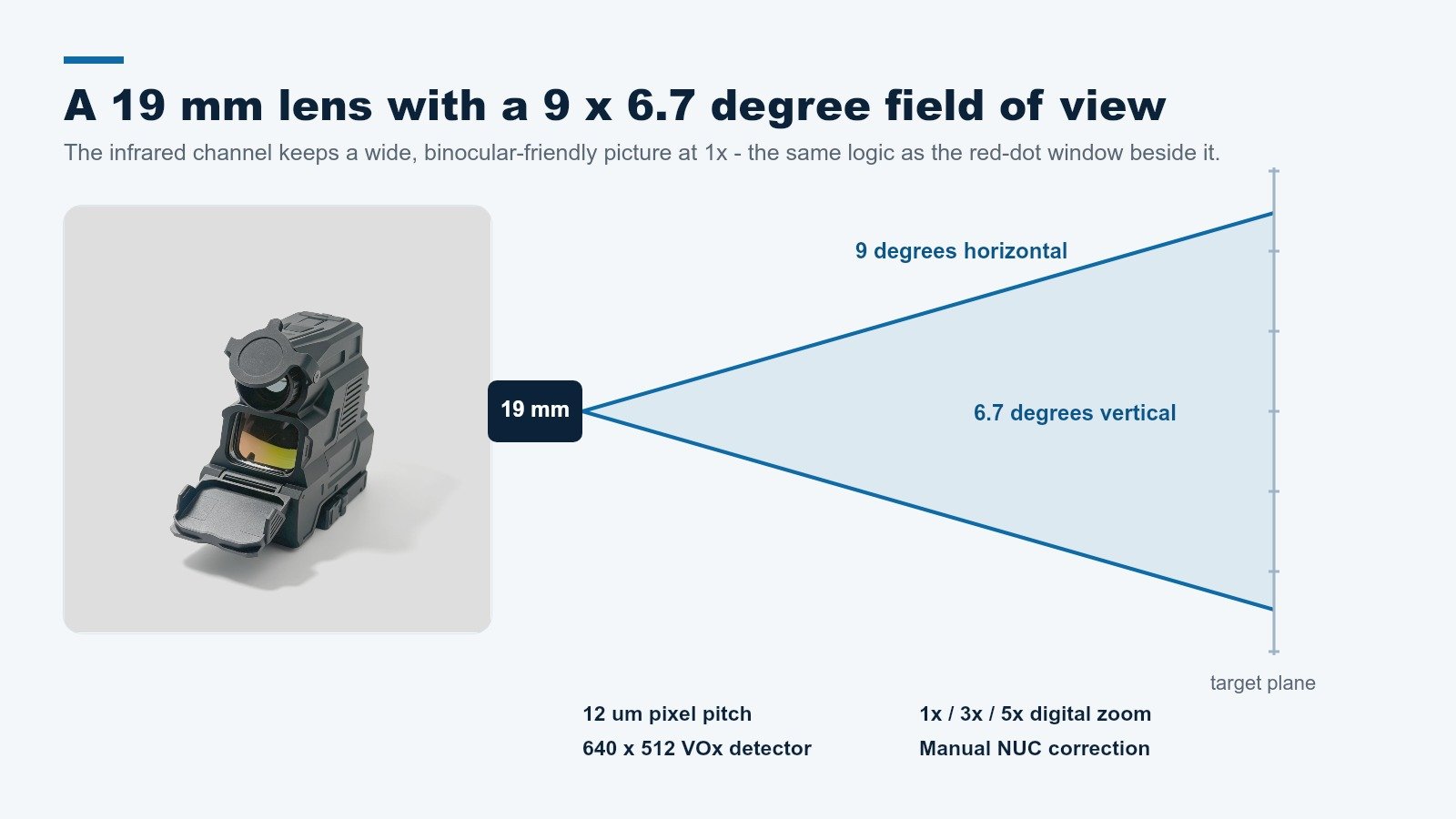
The thermal side of the RDTIFS640 uses the same uncooled vanadium oxide (VOx) detector technology that ERDI-infrared builds into its standalone thermal imaging modules. In the 640 version the detector delivers 640 × 512 pixels at a 12 µm pixel pitch, behind a 19 mm infrared lens that gives a 9° × 6.7° field of view.
Two consequences matter at the sharp end. First, the field of view stays wide and stays at 1×, so the thermal picture supports the same both-eyes-open, close-quarters technique as the red dot instead of forcing the shooter into a narrow magnified tunnel. Second, thermal imaging works on emitted heat rather than reflected light, so smoke, dust, light foliage and total darkness do not blind it in the way they defeat image intensification or white light.
The channel is not fixed at 1× either: the thermal image can be stepped through 1×, 3× and 5× digital zoom for identification, and a manual non-uniformity correction (NUC) routine is available from the keypad when the picture needs it.
What it changes in the field
Adding thermal to a red dot is not a specification exercise; it changes how a team moves and what a single operator can do.
- One weapon, day and night. The sight that is already zeroed for daylight is the sight that works after dark, so patrols do not swap optics, re-zero, or carry a second device for the night half of a shift.
- Faster target acquisition in broken light. Dawn, dusk, deep shadow, vehicle headlights and the glare of a torch are the conditions where a red dot alone is weakest. A thermal overlay remains readable in all of them.
- Detection before identification. A thermal signature is visible from a distance that would show nothing to the naked eye, and the shooter can use the thermal picture to detect while keeping the red dot for the shot.
- Less kit, fewer failure points. One mount, one battery, one zero, one item in the log. Nothing to synchronise between two devices.
- Reduced exposure. Because the target can be detected without white light or a laser, the operator does not have to give away position to see.
Power: one cell, two very different loads
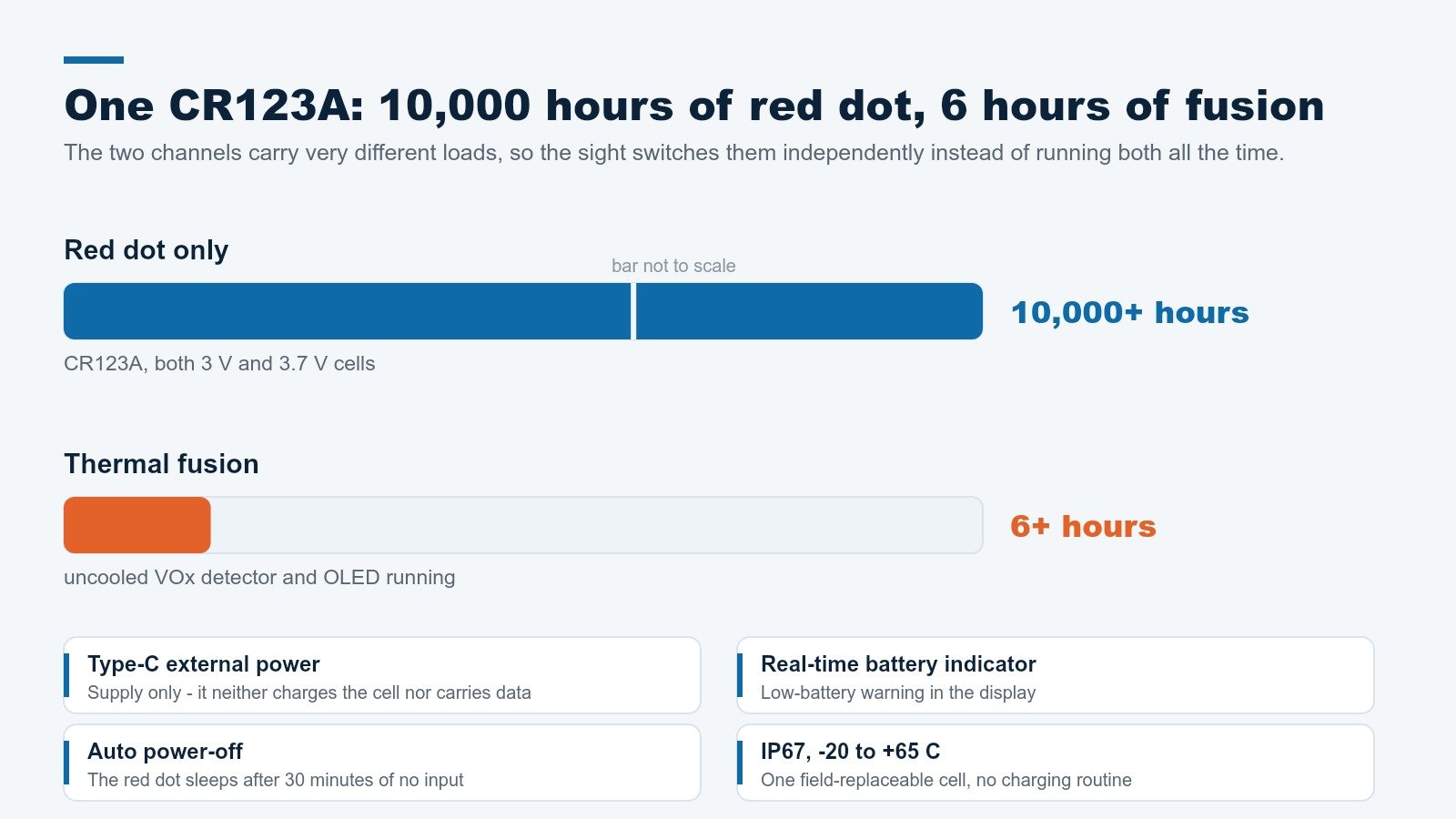
A red-dot emitter draws almost nothing. A 640 × 512 detector, its processing and an OLED display draw considerably more. The RDTIFS640 handles that by keeping the two channels independent rather than running both continuously:
- Red dot only: 10,000+ hours of continuous runtime from a single CR123A (3 V and 3.7 V cells are both supported).
- Thermal fusion: 6+ hours with the infrared channel running.
- External power: a Type-C port on top feeds the sight from a power bank for extended static use. Note that it is a supply input only — it does not charge the internal cell.
- Housekeeping: a real-time battery indicator, a low-battery warning in the display, and an automatic shutdown of the red dot after 30 minutes without input.
In practice, the independence of the two channels is what makes a 10,000-hour figure meaningful: a shooter can run daylight shifts on the red dot alone and bring the thermal channel up only when it earns its current.
Reticles, palettes and how the picture is presented
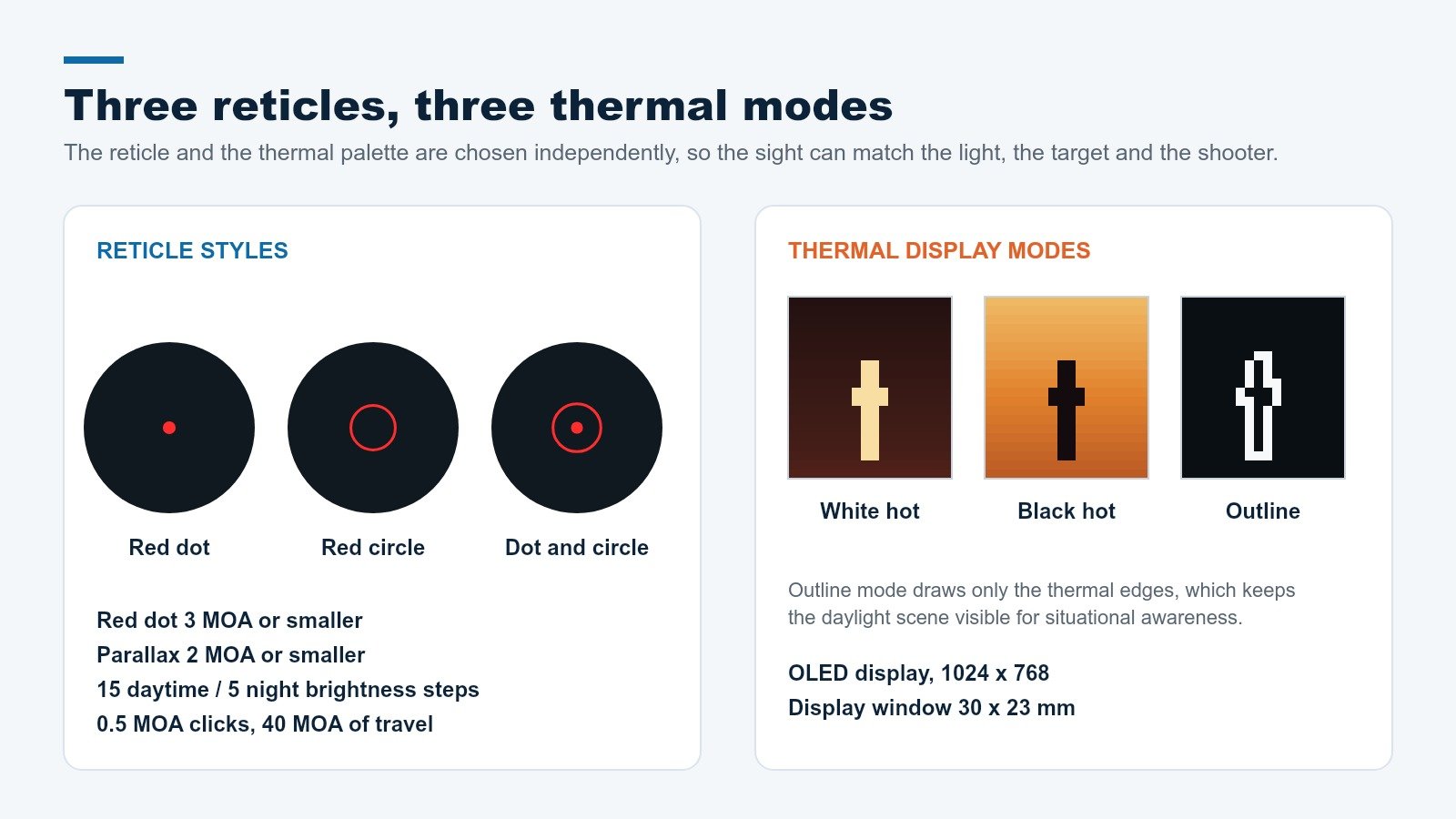
Fusion only helps if the image stays legible. The RDTIFS640 gives the shooter three reticle styles — red dot, red circle, and dot-and-circle, with a dot of 3 MOA or smaller and parallax of 2 MOA or less — and three thermal display modes:
- White hot — warmer objects brighter; the conventional choice for spotting people and vehicles.
- Black hot — inverted, often easier to read against hot ground or in strong sun.
- Outline — draws thermal edges only, so the daylight scene stays visible behind the highlighted contours. For a fusion sight this is the mode that most literally delivers fusion: the shooter keeps situational awareness of the real scene while thermal contours mark what matters.
Brightness is adjustable in 15 daytime steps and 5 night steps for the red dot, with additional infrared brightness levels and the display on a 30 mm × 23 mm window.
Built to be carried, not just to be demonstrated
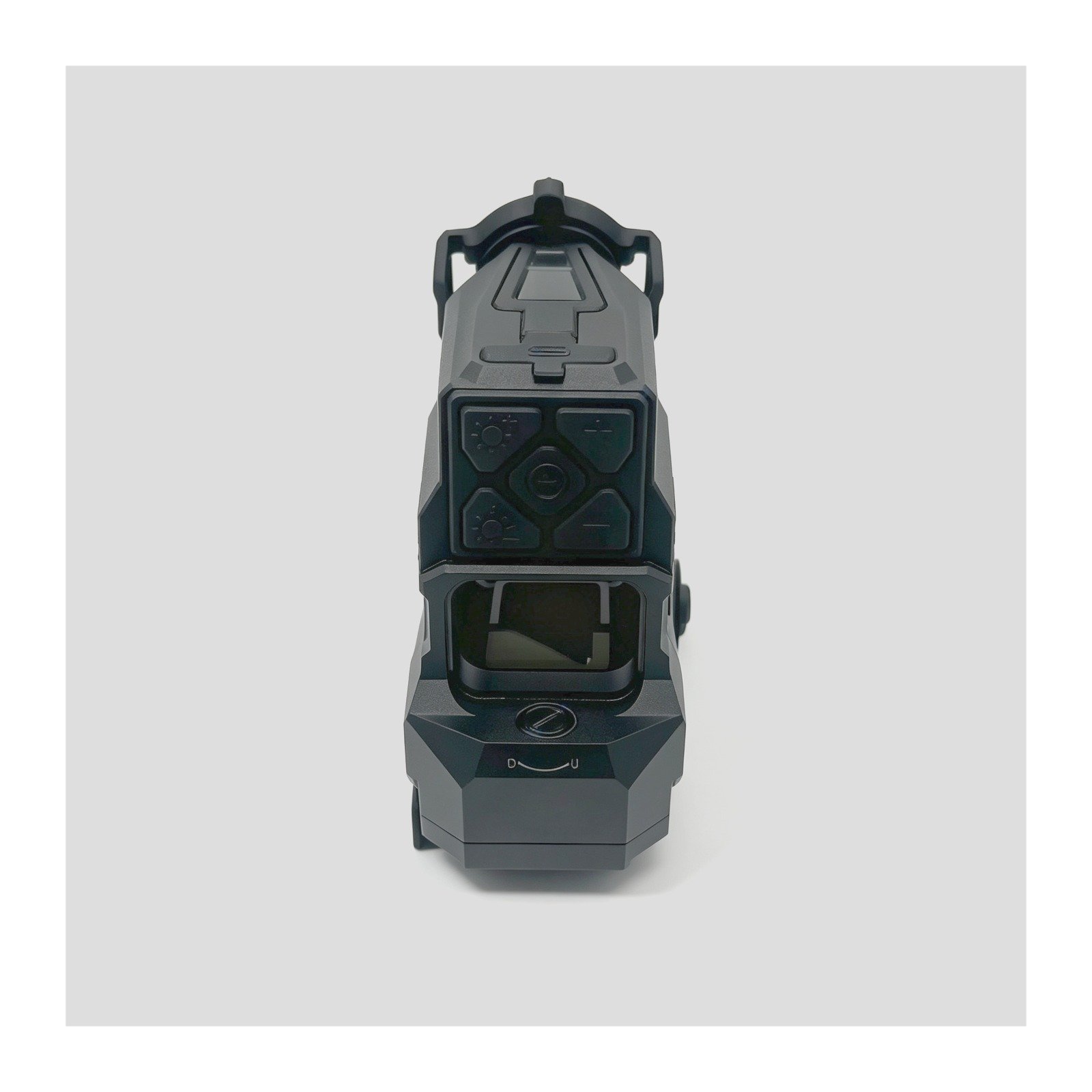
The mechanical specification is deliberately unremarkable in the best sense: a full-metal CNC-machined body with a black hard-anodised finish, a quick-detach Picatinny mount with a lever and adjustment knob, click adjustment of ±40 MOA in elevation and windage at 0.5 MOA per click, and a 38 mm sight line height.
It is sealed to IP67, rated from −20 °C to +65 °C in operation (−40 °C to +70 °C in storage), measures no more than 95 mm × 55 mm × 90 mm, and weighs 450 g. The control set is a keypad with separate illumination and infrared brightness keys, a mode switch and a reticle selector, reachable with gloves.
Choosing between the 256, 384 and 640 versions
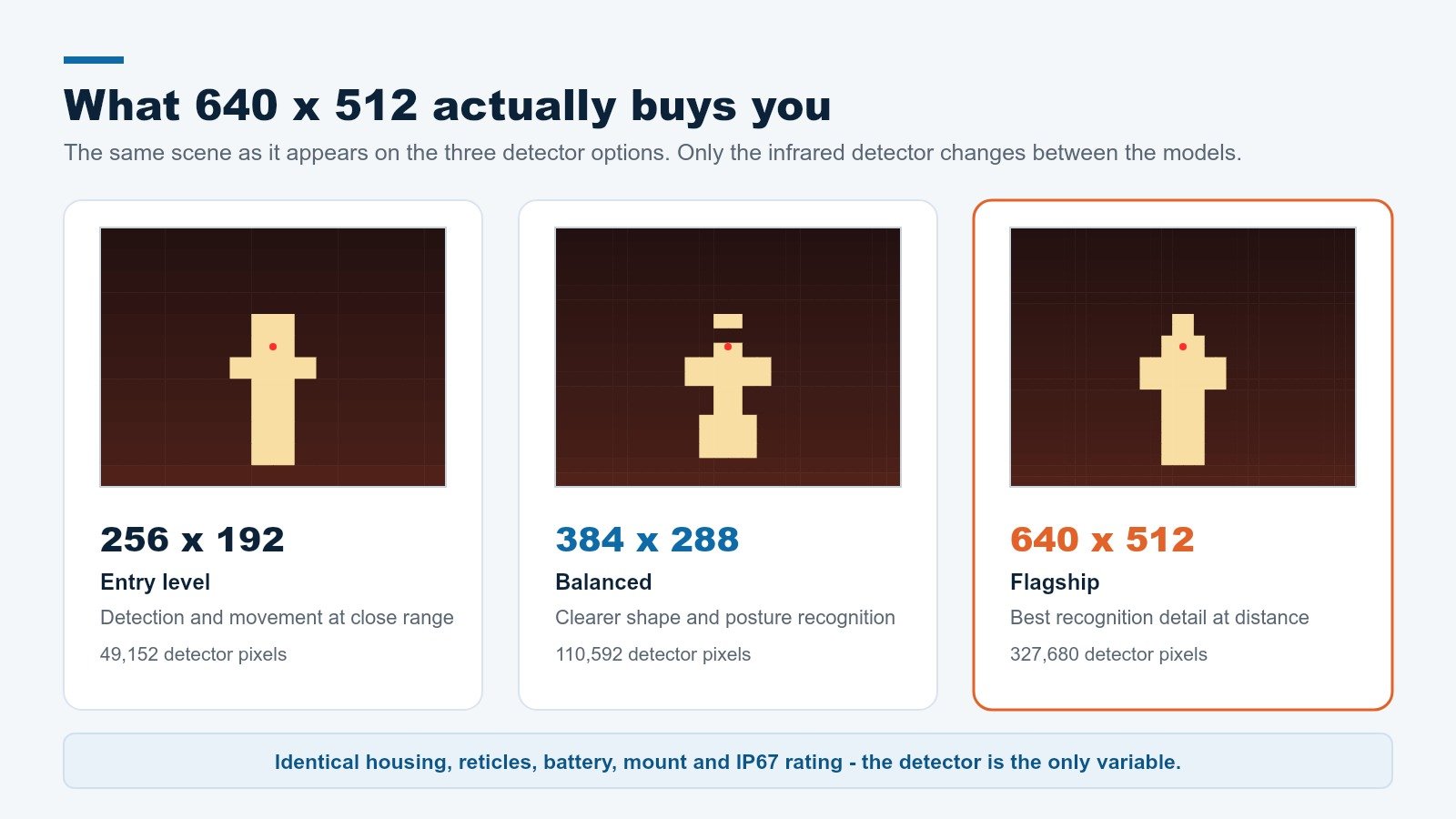
The RDTIFS range is built on one housing, one optical layout, one reticle set, one battery and one set of environmental ratings. The only variable is the infrared detector, which makes the choice unusually simple:
| Model | Detector | What it is for |
|---|---|---|
| RDTIFS256 | 256 × 192 | Entry level — detecting presence and movement at close range, at the lowest cost per unit. |
| RDTIFS384 | 384 × 288 | The balance point — enough resolution to read a posture or a shape at typical engagement distances. |
| RDTIFS640 | 640 × 512 | Flagship — the best recognition detail, and the version to choose when identification at distance matters. |
Detector resolution is also the one specification that cannot be worked around later. Moving from 256 × 192 to 640 × 512 raises the pixel count from 49,152 to 327,680 — 6.7 times the information in the same field of view, which is the difference between a warm shape and a recognisable one.
An honest note on what the fusion sight does not do
The RDTIFS640 does not record. There is no onboard video or audio capture, no microphone and no internal storage, and the Type-C port is a power input rather than a data or charging port. For a weapon sight that is a defensible engineering choice — a recording pipeline would add heat, current draw and another failure mode inside a 450 g sealed housing — but it is a requirement that should be settled before a programme is specified, not after. Buyers who need recoil-activated video with a microphone should look at ERDI-infrared’s thermal riflescope range, which includes those functions.
Where fusion sights fit in a modern kit
The red-dot thermal fusion sight sits between two established categories. It is more flexible than a pure red dot, because it works after dark without a separate night device. It is faster and lighter than a magnified thermal weapon sight for close-quarters work, because it keeps the 1× both-eyes-open technique that made the red dot dominant in the first place.
For the system integrators and OEM buyers who already work with ERDI-infrared on thermal modules, the same detector supply chain and the same uncooled VOx technology sit inside this sight — which is why the family can be specified with 256 × 192, 384 × 288 or 640 × 512 detectors on a shared mechanical platform, and why OEM and ODM customisation, branding and mounting variants can be discussed on the same basis as the module business.
Frequently asked questions
Is the thermal image always on?
No. The red dot and the infrared channel are switched on and off independently. Daylight work can be done on the red dot alone, which is how the 10,000+ hour figure is reached; the thermal channel is brought up when the light or the task calls for it.
Do I have to re-zero when I switch to thermal?
No. Both channels are presented in the same window on the same 1× sight line, so the zero, the cheek weld and the head position do not change between modes.
Can it be used with both eyes open?
Yes. The sight is a 1× optic with a 30 mm × 23 mm viewing window, so the standard both-eyes-open technique used with a red dot applies, with the thermal image presented inside the same window.
Is there a laser rangefinder or ballistic calculator?
No. Those functions belong to ERDI-infrared’s thermal riflescope models. The fusion sight is deliberately focused on the day/night aiming problem rather than on long-range firing solutions.
What is the detection range?
Detection distance depends on target size, thermal contrast and atmospheric conditions, so it is quoted per application rather than as a single number. Share the target specification and the expected conditions and ERDI-infrared will calculate the expected range for the 256, 384 or 640 detector.
Summary
Infrared thermal imaging and the red dot solve two halves of the same problem: one finds the target when there is no light, the other puts a bullet on it quickly and with both eyes open. Keeping them in one 1× window, on one zero, powered by one CR123A, is what the RDTIFS640 adds — and it is the reason a fusion sight changes the kit list rather than adding to it.
Full specifications for the RDTIFS640 are on the product page, and the PDF datasheet can be downloaded directly. For detector options, OEM/ODM discussion or volume pricing, contact the ERDI-infrared team.
Related reading: Advantages of Waveguide Technology in Weapon Sights and Essential Considerations When Integrating an Infrared Thermal Imaging Module into Your System.