


640×512 vs 1280×1024: Does Higher Resolution Actually Extend Detection Range?
Two thermal modules, the same 19 mm lens, one 640×512 detector and one 1280×1024: they detect a person at exactly the same distance. The bigger format does not see further — it sees wider. That single fact decides a large share of module choices, and it is worth walking through the arithmetic before a specification is fixed.
Specification sheets put resolution first, so a 1280×1024 module reads as “more capable” than a 640×512 one. Sometimes it is — for coverage, for crop headroom, for detail at short range. For reach at a given focal length, it is not.
Resolution sets the scene, the lens sets the reach
What limits a thermal module’s range is its instantaneous field of view (IFOV): the angle one pixel subtends. IFOV is pixel pitch divided by focal length, and it has nothing to do with how many pixels sit beside it.
IFOV (mrad) = pixel pitch (µm) ÷ focal length (mm)
Multiplying IFOV by range gives the ground footprint of one pixel:
pixel footprint (m) = IFOV (mrad) × range (m) ÷ 1000
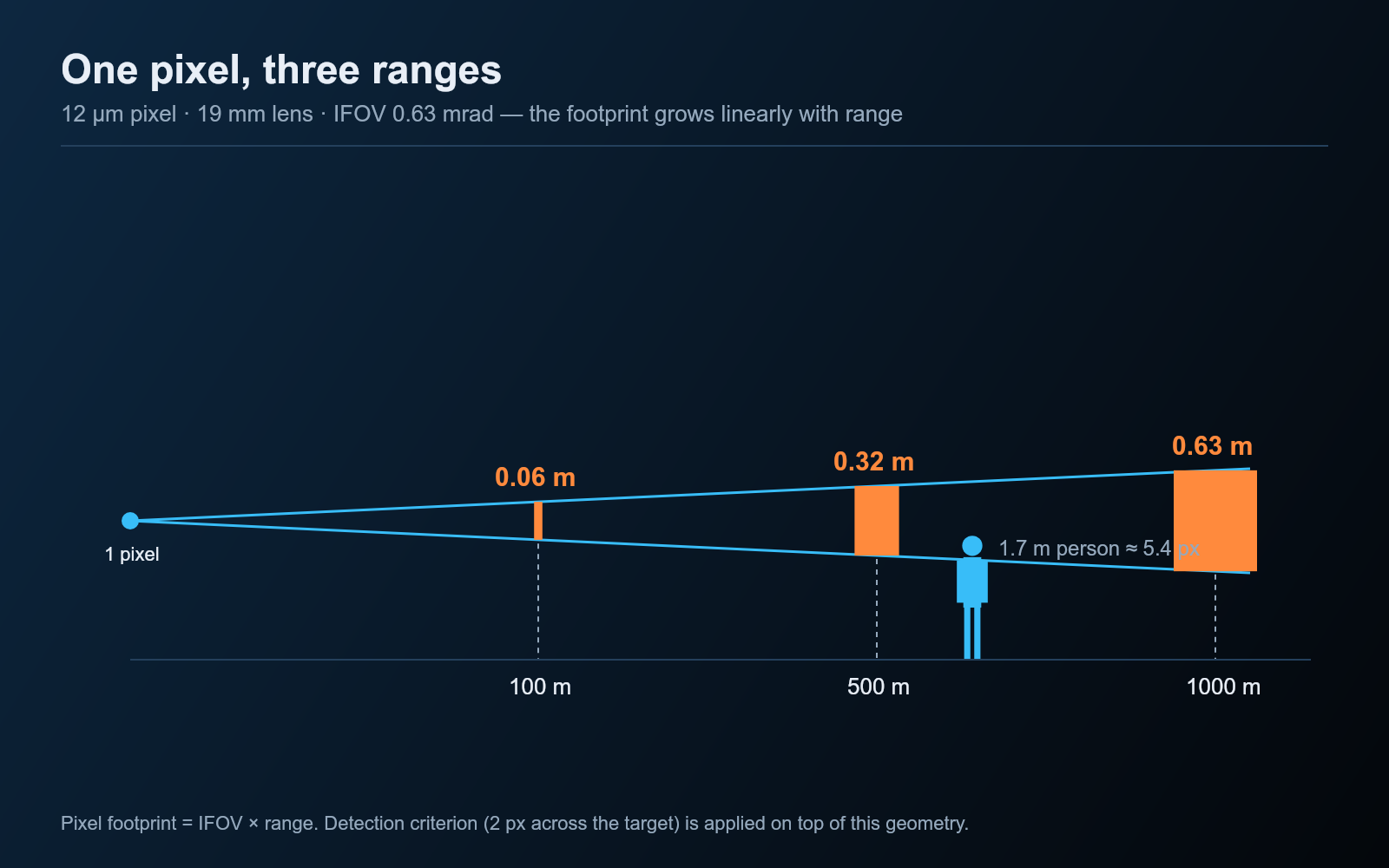
A 12 µm pixel behind a 19 mm lens subtends about 0.63 mrad. One pixel therefore spans roughly 0.32 m at 500 m and 0.63 m at 1,000 m. Detection is a criterion on top of that geometry — commonly two pixels across the target’s critical dimension — but the geometry itself is fixed by pitch and focal length alone.
Same lens, two formats: the numbers do not move
Take a 1.7 m person as the target and two pixels across the critical dimension as the detection criterion, with 12 µm pixels behind the same 19 mm lens in both cases:
| Parameter | 640×512 / 12 µm / 19 mm | 1280×1024 / 12 µm / 19 mm |
|---|---|---|
| Pixel pitch | 12 µm | 12 µm |
| Focal length | 19 mm | 19 mm |
| IFOV | 0.63 mrad | 0.63 mrad |
| Pixel footprint at 500 m | 0.32 m | 0.32 m |
| Person height at 500 m | ≈ 5.4 pixels | ≈ 5.4 pixels |
| Detection distance | identical | identical |
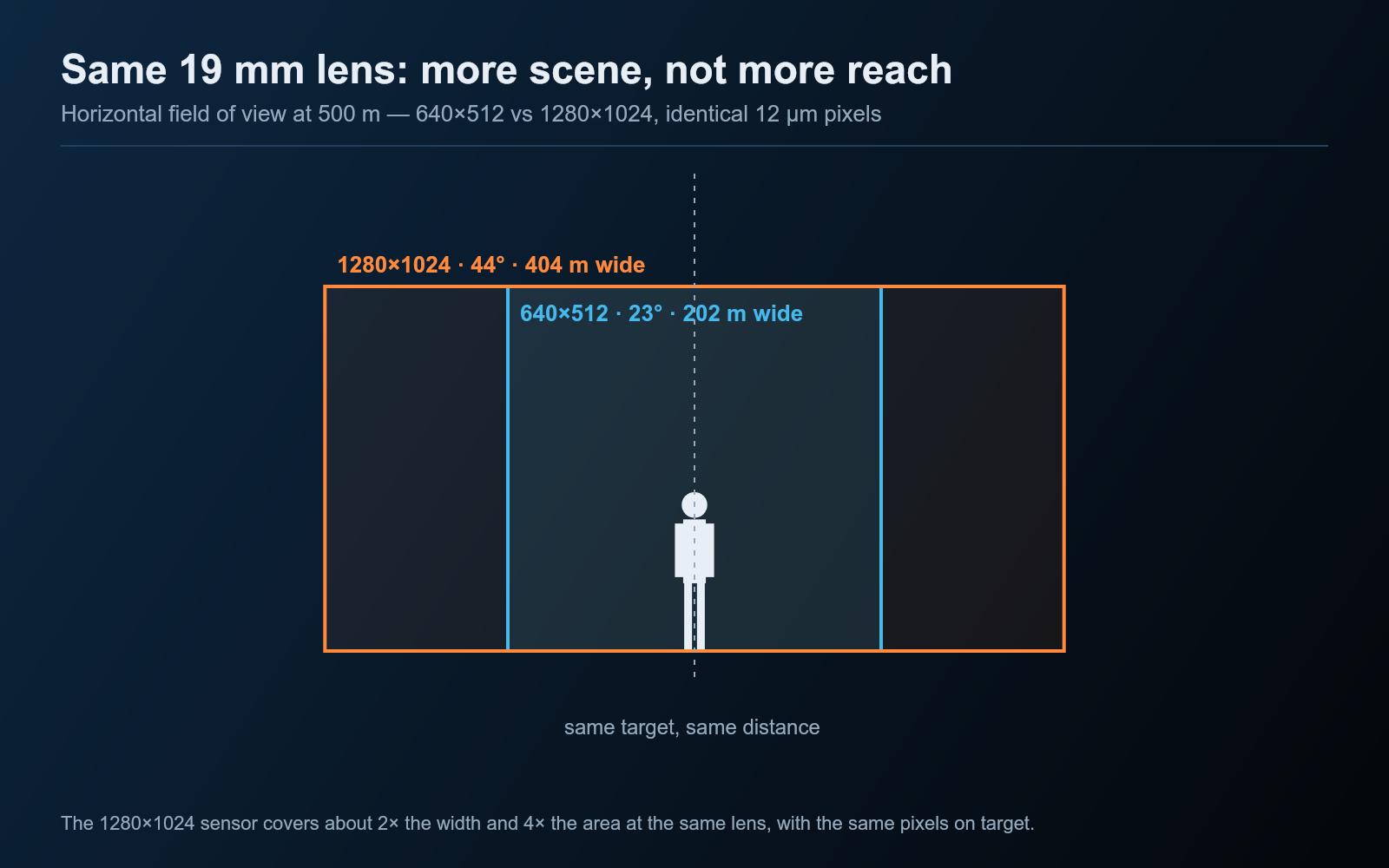
| Horizontal field of view | ≈ 23° | ≈ 44° |
| Scene covered (same range) | 1× | ≈ 2× horizontally, ≈ 4× area |
Nothing about reach changed, because nothing about the pixel geometry changed. What changed is how much scene arrives at the sensor. In a fixed installation that is often the more valuable property: one 1280×1024 camera can hold a wider fence line than a 640×512 camera at the same lens, with the same number of pixels on a target in the middle of the frame.
What 1280×1024 actually buys — and what it costs
Three honest gains
- Coverage without stitching. Roughly twice the horizontal and twice the vertical field at the same focal length, so fewer units cover a perimeter or a corridor.
- Crop headroom. Because the sensor captures about four times the area, you can crop to the centre and still hold 640×512 worth of pixels. That is a real operating benefit — but it is a crop, not additional reach.
- Detail at close range. At 50–150 m a 1280×1024 format puts noticeably more pixels on a small object, which matters for inspection and identification rather than for long-range detection.
Three real costs
- Four times the data. Bandwidth, storage and compression budget scale with pixel count, and on a UAV that is payload weight and power.
- Bigger, heavier optics if you want the wide field and a small pixel footprint simultaneously.
- More processing in the channel: video pipeline, encoder and interface all grow with the frame.
When resolution does extend the range
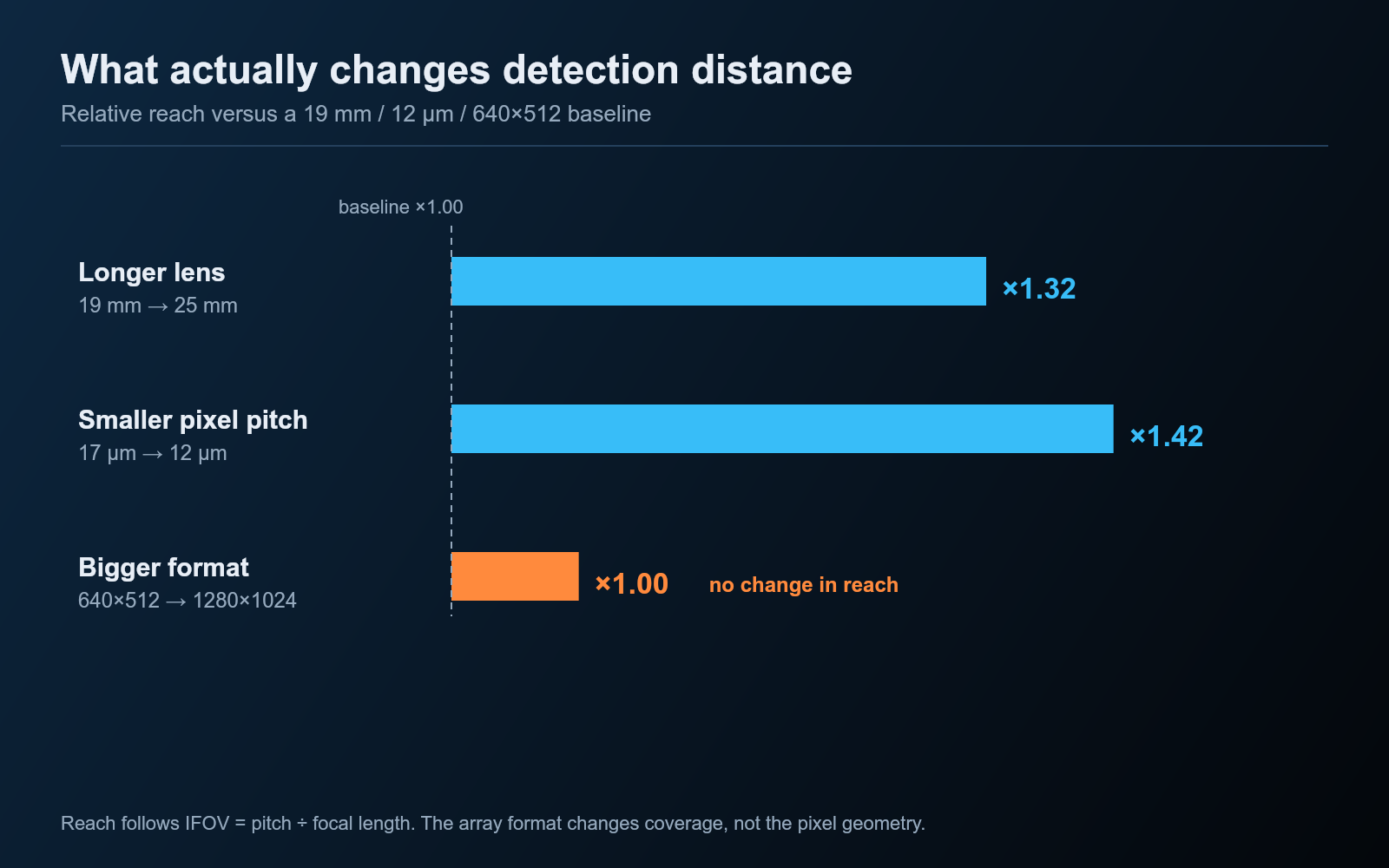
Reach improves only when IFOV shrinks. That happens in two ways, and neither of them is “choose the larger array”:
- Shorter pixel pitch at the same focal length. Going from 17 µm to 12 µm shrinks IFOV by about 1.4×, which extends the detection distance by the same factor — at the cost of light per pixel, so check the NETD rather than the pitch alone.
- Longer focal length at the same pitch. Going from 19 mm to 25 mm at 12 µm extends reach by about 1.3×, and narrows the field of view by the same factor.
Put differently: if the question is “how far”, the answer is a lens-and-pitch calculation. If the question is “how much of the site”, the answer is the array format.
Choosing between the two formats
| Application | Format that usually fits | Reason |
|---|---|---|
| UAV gimbal, 300–500 m class, tight weight and power | 640×512 | Enough pixels at the required range with a quarter of the data |
| Perimeter fence line, fixed mount, wide coverage | 1280×1024 | One unit covers what two narrower modules would |
| Handheld observation and patrol | 640×512 | Smaller optics and lower power for the same reach |
| Long-range detection with a narrow field | Either, with a longer lens | Reach comes from focal length; the format only sets how much you waste on the sides |
| Close-range inspection and identification | 1280×1024 | More pixels on small targets at short distances |
Run the numbers for your own geometry
The figures above assume 12 µm pitch, a 19 mm lens, a 1.7 m target and a two-pixel detection criterion. Your target, lens and criterion will differ, and real systems are also limited by NETD, atmospheric transmission and the display rather than by geometry alone. The free thermal imaging module selection calculator runs the same arithmetic for your numbers and shows where the detection, recognition and identification distances land.
For the wider selection framework — NETD, lens choice, interface and video standards — see the uncooled LWIR core selection guide, and for a worked end-to-end example with real assumptions see the UAV gimbal worked example.
Frequently asked questions
Does a 1280×1024 module detect a person farther than a 640×512 module?
Not at the same focal length. With equal pixel pitch the geometry is identical, so the detection distance is identical; the 1280×1024 sensor simply covers more scene. It detects farther only when the lens is longer or the pixel pitch is smaller.
Is a smaller pixel pitch always better for range?
It buys range at the same lens, but a smaller pixel collects less light, so NETD and the lens F-number matter as much as the pitch. A 12 µm detector with a poor NETD can lose the range its geometry promises.
What if I need a wide view and a long range at once?
Use two cameras — a wide module and a narrow one — or a single 1280×1024 sensor behind a longer lens with a crop for the wide view. The calculator shows both options side by side.
This note is a design exercise with the assumptions stated above. It is not a measurement of any specific product; re-run the arithmetic with your own lens, detector and criterion before fixing a specification.