


Specifying a thermal channel for a UAV gimbal: a worked example
Most thermal channel decisions start with a resolution, and that is the wrong end. This worked example starts from the mission — what the operator must see, at what range, over what search area — and arrives at a detector, a lens and a set of numbers you can argue with.
This is a design exercise with stated assumptions rather than a report of a delivered system: the parameters are listed so you can change them.
Every figure below was calculated with the same formulae as our free thermal imaging module selection calculator. The payload is a 1.2 kg-class stabilised gimbal on a small fixed-wing or multirotor platform.
Assumptions used throughout (change them and the answer changes):
- Target: a standing adult, 0.5 m critical dimension; vehicles 2.3 m
- Detector pixel pitch: 12 µm
- Search requirement: a wide enough field of view to find the target, then enough pixels to classify it
- Geomatic figures only — the practical column applies a de-rating factor for haze and thermal contrast
Step 1 — What the operator actually needs
Two questions, asked in this order:
- How wide must the search field be? If the operator is looking for a person in open ground, the field of view decides how quickly the area is covered.
- At what range must the target be classified, not just spotted? Detection at 2 px on target means “something is there”. Recognition at 8 px means “that is a person”.
Those two answers pull in opposite directions, which is the whole problem.
Step 2 — Candidate configurations
Holding the detector pitch at 12 µm and varying only the detector format and lens:
Table A — candidate configurations
| Option | Detector | Lens | HFOV | VFOV | IFOV | FOV width @ 200 m | Human detection | Human recognition | Vehicle detection |
|---|---|---|---|---|---|---|---|---|---|
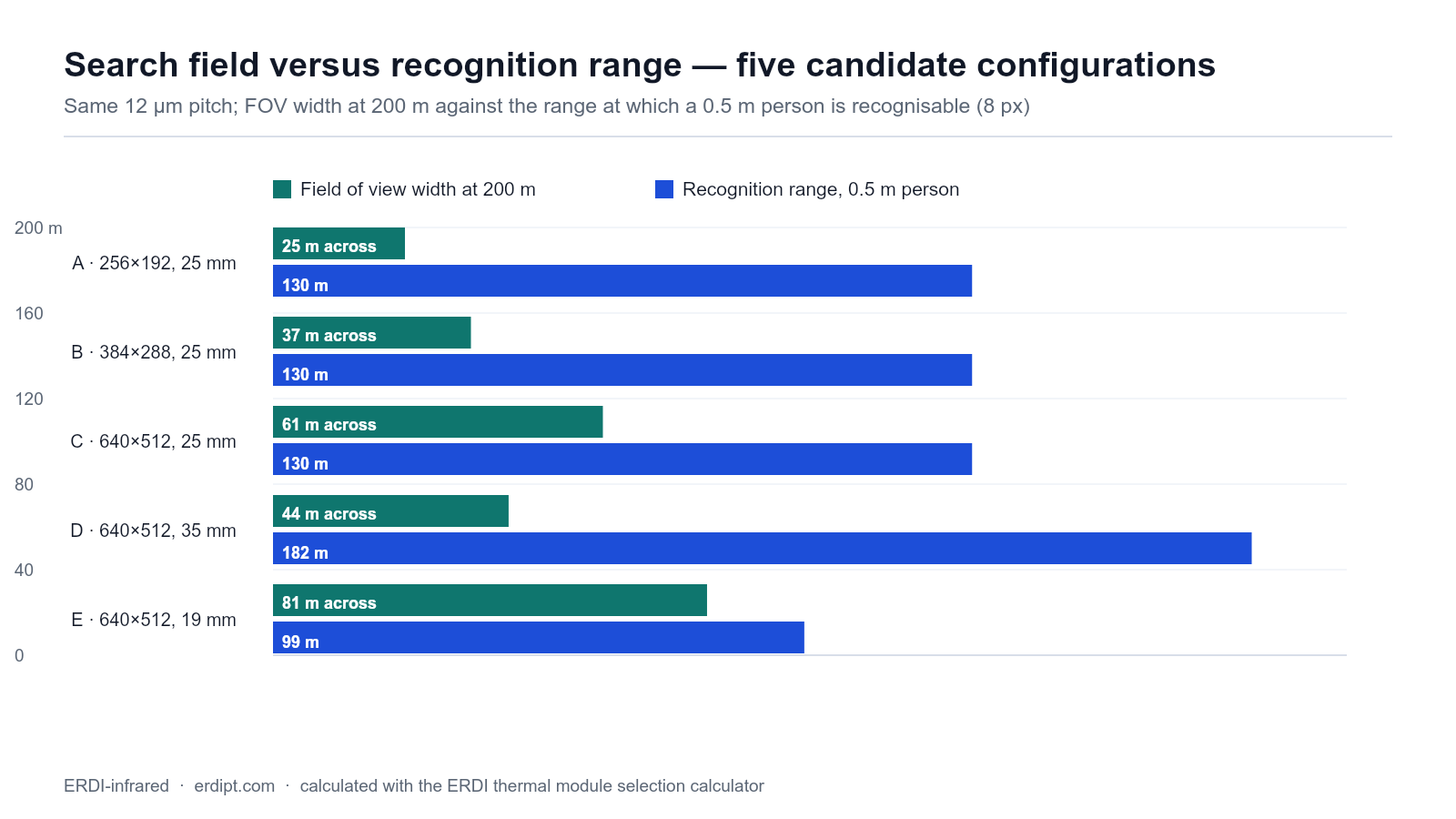
| A | 256 × 192 | 25 mm | 7.0° | 5.3° | 0.48 mrad | 24.6 m | 521 m | 130 m | 2,396 m |
| B | 384 × 288 | 25 mm | 10.5° | 7.9° | 0.48 mrad | 36.9 m | 521 m | 130 m | 2,396 m |
| C | 640 × 512 | 25 mm | 17.5° | 14.0° | 0.48 mrad | 61.4 m | 521 m | 130 m | 2,396 m |
| D | 640 × 512 | 35 mm | 12.5° | 10.0° | 0.34 mrad | 43.9 m | 729 m | 182 m | 3,354 m |
| E | 640 × 512 | 19 mm | 22.9° | 18.4° | 0.63 mrad | 80.8 m | 396 m | 99 m | 1,821 m |
Read the detection and recognition columns carefully: with the same lens, all three formats give the same numbers on a centred target. That is not a mistake — range on target is set by the instantaneous field of view (pixel pitch ÷ focal length), not by how many pixels the array has. What the format buys you is the search field: at 200 m, option A covers 24.6 m across, option C covers 61.4 m.
This is the single most useful thing to understand before buying anything: resolution extends range only when you pair it with a proportionally longer lens at the same field of view (that comparison is in our selection guide).
Step 3 — Choose a thermal channel and check it at real ranges
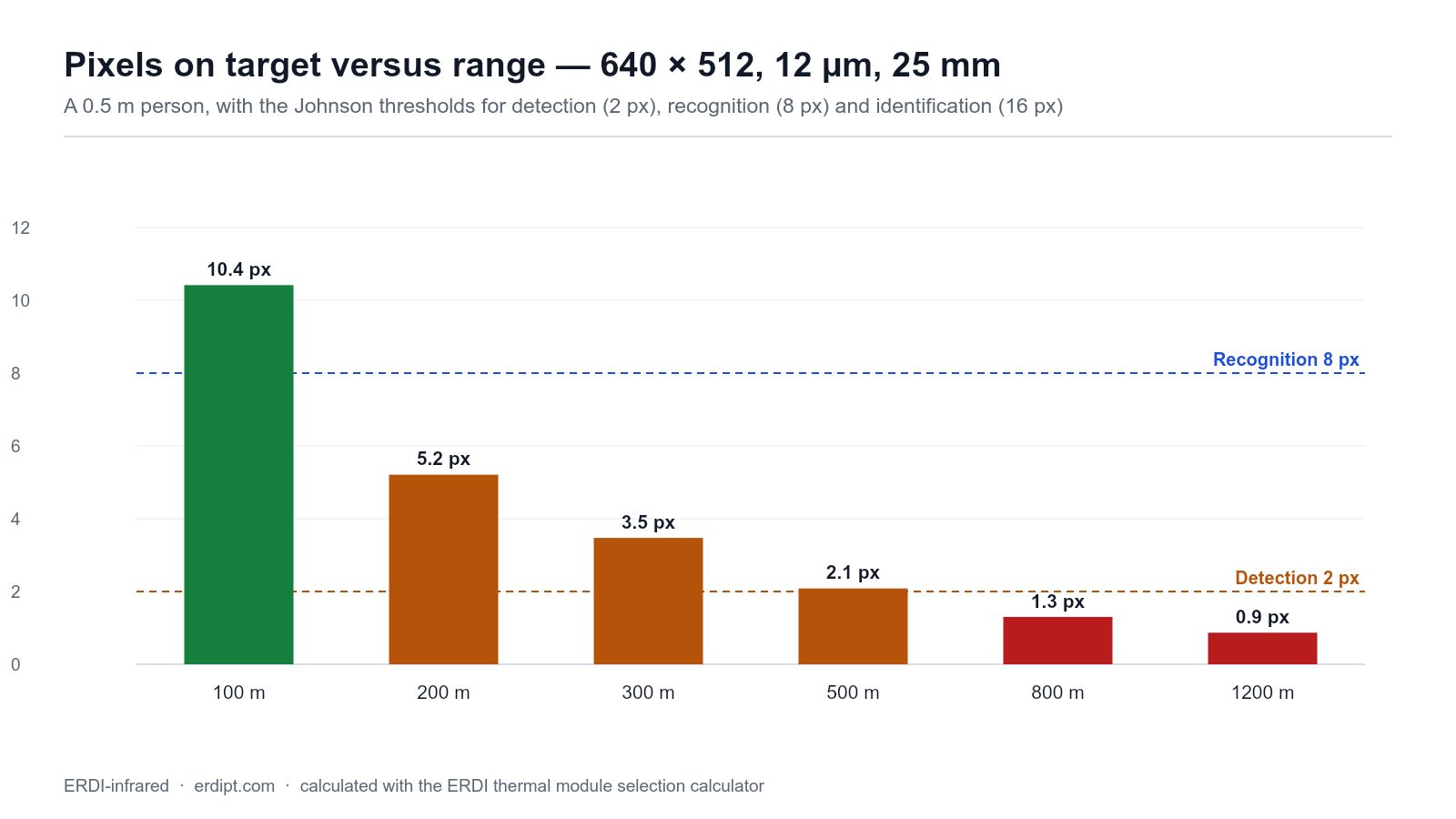
For a gimbal that must search and then classify, option C (640 × 512, 25 mm) is the balanced starting point: 17.5° of search field and 0.48 mrad per pixel.
Table B — what option C resolves at typical UAV ranges
| Range | Pixels on a 0.5 m person | Pixels on a 2.3 m vehicle | Verdict (person) |
|---|---|---|---|
| 100 m | 10.4 px | 47.9 px | Recognition |
| 200 m | 5.2 px | 24.0 px | Detection only |
| 300 m | 3.5 px | 16.0 px | Detection only |
| 500 m | 2.1 px | 9.6 px | Detection only |
| 800 m | 1.3 px | 6.0 px | Below detection |
| 1200 m | 0.9 px | 4.0 px | Below detection |
Two things this table makes obvious:
- A person is recognisable out to roughly 130 m and detectable to about 500 m with this channel. If the mission is “identify a person at 400 m”, this channel fails — and no amount of image processing fixes a 2-pixel target.
- A vehicle is a much easier target: still 9.6 px at 500 m.
Table C — the same channel, de-rated for real conditions
| Conditions | Factor | Detection (0.5 m) | Recognition (0.5 m) | Identification (0.5 m) |
|---|---|---|---|---|
| Clear, high ΔT | ×1.00 | 521 m | 130 m | 65 m |
| Average haze / moderate ΔT | ×0.80 | 417 m | 104 m | 52 m |
| Haze, rain or low ΔT | ×0.65 | 339 m | 85 m | 42 m |
Quote the second column to a customer, not the first.
Step 4 — If the requirement changes
- “We need to recognise a person at 400 m.” Move to option D (35 mm): recognition goes to 182 m — still short. You need a longer lens and a narrower field, or a different concept (a second, narrow channel; or a different platform altitude). This is why dual-channel gimbals exist: a 9–19 mm channel to find, a 35–50 mm channel to look.
- “We need a wider search field.” Option E (19 mm): 22.9° and 80.8 m across at 200 m, at the cost of range (detection 396 m).
- “We need it lighter.” Go back to option B or A, and accept the narrower field — or move to a smaller pitch detector so that a shorter lens delivers the same IFOV.
Step 5 — What these numbers do not cover
Range arithmetic is only the first filter. Before committing to a payload, fill in the rest of the budget with measured figures, not datasheet optimism:
- SWaP-C: core mass, lens mass, housing and window, interface board; steady-state power and start-up surge; total optical head mass against your gimbal’s payload allowance.
- Latency: sensor-to-video-out, measured. A 30 Hz stream with 120 ms of processing latency is unusable for a fast tracking loop.
- Athermalisation: does focus hold from −20 °C to +50 °C? Is focus motorised, or passive?
- Interface: does the core’s output match your encoder, and does the SDK expose the controls you need (NUC, AGC, palettes, radiometry)?
- Mechanical and environmental: lens mount stiffness on a stabilised gimbal, sealing of the finished assembly, vibration to your platform’s standard.
- Compliance: thermal hardware is a dual-use item in many jurisdictions; confirm the classification and the documentation your supplier provides before designing it into an exported product.
Step 6 — Run your own numbers
Change the detector, the lens or the target in our thermal imaging module selection calculator and the tables above recompute for your mission. If you send us your target, platform, resolution, interface and estimated annual quantity, our engineers will reply with a configuration proposal — see the ERUTM and ERUSTM module range or talk to an engineer.