

Understanding Infrared Detector Pixel Pitch: Why Pixel Size Matters in Thermal Imaging
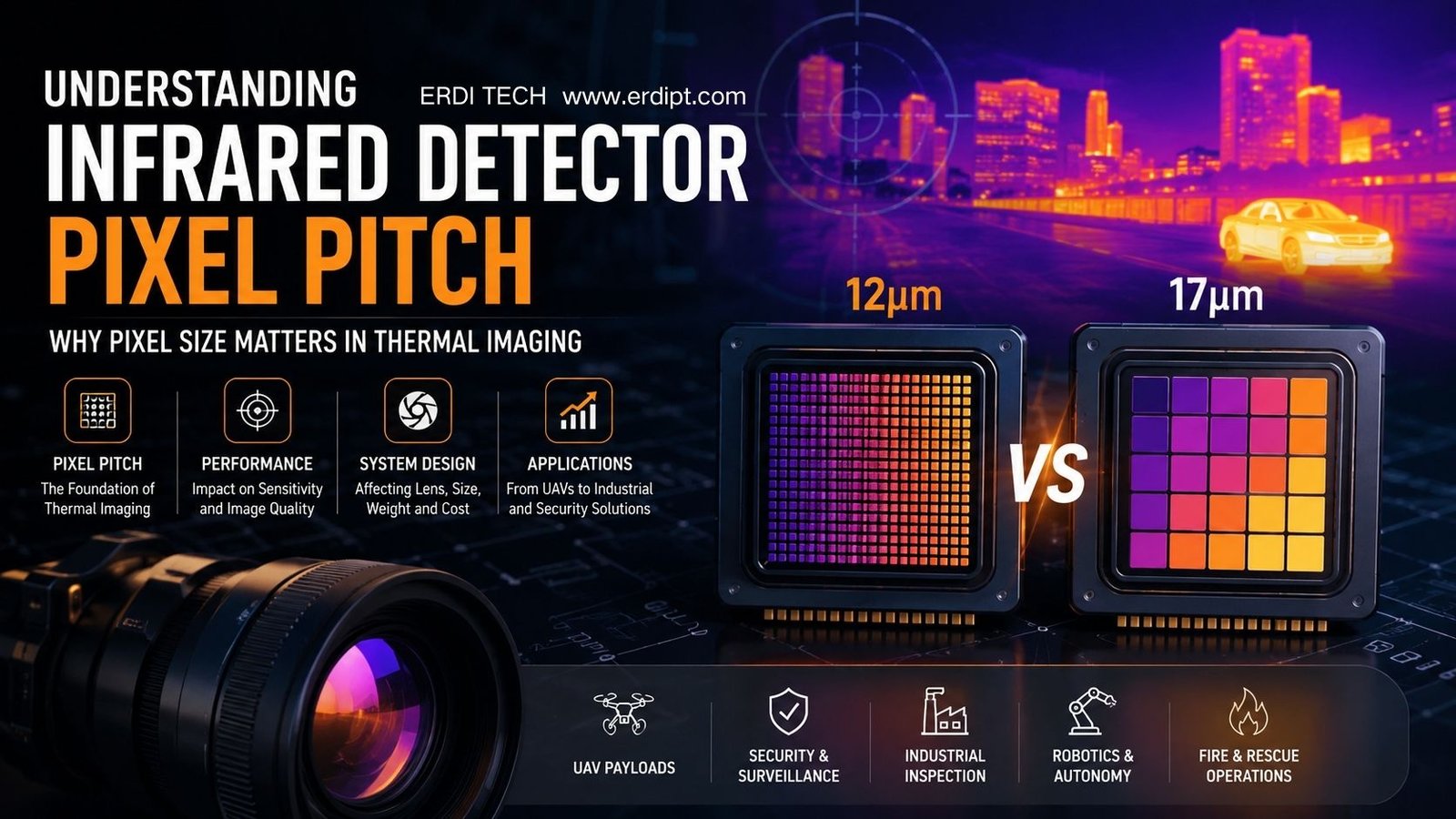
Quick answer: pixel pitch is a design trade-off To see what a given pixel pitch and focal length actually resolve at range, use our free thermal imaging module selection calculator.
If you’ve ever compared thermal imaging cameras or infrared modules, you’ve probably come across specifications such as 12μm, 15μm, or 17μm Pixel Pitch.
For many newcomers, these numbers can be confusing. Does a smaller pixel automatically produce a better image? Why do some high-end thermal cameras still use larger pixels? How does pixel pitch affect image quality, detection distance, lens size, and overall system performance?
The truth is that pixel pitch is one of the most important specifications of an infrared detector, but it is also one of the most misunderstood.
A difference of only a few micrometers may seem insignificant, yet it can influence everything from the size of the infrared lens to manufacturing costs, image resolution, portability, and even the overall design philosophy of a thermal imaging system.
In this guide, we’ll explain infrared detector pixel pitch in clear, easy-to-understand language. Whether you’re an engineer, a purchasing manager, a system integrator, or simply interested in thermal imaging technology, this article will help you understand what pixel pitch really means and how it affects real-world applications.
What Is an Infrared Detector?
Before discussing pixel pitch, it’s important to understand the role of an infrared detector.
Unlike conventional cameras, which capture visible light reflected from objects, infrared detectors capture thermal radiation naturally emitted by everything around us.
Every object with a temperature above absolute zero continuously emits infrared energy. People, vehicles, buildings, electrical equipment, animals, and even the ground beneath our feet all produce infrared radiation. The warmer an object becomes, the stronger its infrared emission generally is.
An infrared detector converts this invisible thermal radiation into electrical signals. These signals are then processed by specialized image processing algorithms to create the thermal images displayed on a screen.
This capability allows thermal cameras to operate in complete darkness, through smoke, light fog, and many challenging environments where visible-light cameras struggle.
Because of these advantages, infrared detectors are widely used in numerous industries, including:
- UAV and drone payloads
- Security and border surveillance
- Firefighting and rescue operations
- Industrial inspection and predictive maintenance
- Automotive Advanced Driver Assistance Systems (ADAS)
- Robotics and autonomous navigation
- Marine observation
- Wildlife monitoring
- Medical and scientific research
No matter the application, every infrared detector is built around thousands—or even millions—of tiny sensing elements. These sensing elements are called pixels, and the physical size of each pixel is known as the pixel pitch.
What Is Pixel Pitch?
Pixel pitch refers to the physical distance between the centers of two adjacent pixels on an infrared detector. In practice, it also represents the approximate size of each individual sensing element.
Pixel pitch is usually measured in micrometers (μm).
Common pixel pitch values found in today’s thermal imaging industry include:
- 12 μm
- 15 μm
- 17 μm
- 20 μm
To appreciate how small these dimensions are, consider the following comparisons:
- A human hair is approximately 70 micrometers in diameter.
- A typical red blood cell measures about 7 micrometers across.
- A 12 μm infrared pixel is only about one-sixth the width of a human hair.
Although each pixel is incredibly small, modern infrared detectors contain hundreds of thousands of them arranged in a highly precise array.
For example:
A 640 × 512 infrared detector contains:
640 × 512 = 327,680 individual sensing pixels
Each pixel independently detects the infrared energy coming from a tiny portion of the observed scene. Together, these hundreds of thousands of measurements create a complete thermal image.
You can think of the detector as a giant grid made up of microscopic “temperature sensors.” Every sensor measures its own tiny area, and image processing software combines all of these measurements into the colorful thermal images we see.
How Does Pixel Pitch Work?
One of the easiest ways to understand pixel pitch is to imagine placing buckets outside during a rainstorm.
Suppose each bucket represents one infrared pixel.
The rain represents incoming infrared radiation.
Now compare two situations.
In the first scenario, each bucket is relatively large.
Because the opening is wider, each bucket collects more rainwater over the same period of time.
In the second scenario, the buckets are much smaller.
Each bucket captures less rain, making it more difficult to accurately measure how much rain has fallen.
Infrared pixels behave in a very similar way.
A larger pixel has a larger surface area that receives more infrared energy. Because it collects more signal, the resulting electrical output is generally stronger, making it easier to distinguish useful information from electronic noise.
Smaller pixels collect less infrared energy individually. This means the detector must rely on more advanced semiconductor manufacturing processes, lower-noise readout circuits, and increasingly sophisticated image processing algorithms to maintain excellent image quality.
This is one reason why reducing pixel pitch has always been considered a significant engineering challenge.
Modern 12 μm detectors have become commercially successful not simply because the pixels are smaller, but because improvements in detector materials, fabrication technology, signal processing, and image enhancement algorithms have compensated for the reduced signal collected by each pixel.
In other words, pixel pitch is never an isolated specification. It works together with detector sensitivity, NETD, optical design, image processing, and system engineering to determine the final performance of a thermal imaging camera.
Understanding this relationship is essential before comparing different detector specifications, because a smaller pixel does not automatically guarantee a better thermal image.
In the next section, we’ll explore why the thermal imaging industry has gradually shifted from 17 μm to 12 μm detectors, what advantages smaller pixels provide, and why larger pixels are still preferred in certain high-performance applications.
Why the Industry Is Moving from 17 μm to 12 μm Pixels
For many years, 17 μm pixel pitch was the mainstream choice for uncooled infrared detectors. It offered stable performance, mature manufacturing processes, and excellent image quality, making it widely adopted in military systems, industrial equipment, and early-generation thermal cameras.
Today, however, 12 μm detectors have become the new industry standard for many commercial and industrial thermal imaging applications.
This transition did not happen overnight. It is the result of continuous advances in semiconductor fabrication, detector materials, optical engineering, and image processing technologies.
So why has the industry gradually moved toward smaller pixels?
The answer lies in system-level optimization rather than a single performance improvement.
Smaller Detectors Enable Smaller Cameras
One of the biggest advantages of reducing pixel pitch is that the detector itself becomes physically smaller.
Imagine two infrared detectors with exactly the same resolution of 640 × 512 pixels.
Because each pixel occupies less space, a 12 μm detector has a significantly smaller sensing area than a 17 μm detector.
This reduction may seem minor on paper, but it creates substantial benefits throughout the entire camera design.
A smaller detector generally leads to:
More compact camera dimensions
Lower overall system weight
Easier integration into portable devices
Reduced power consumption in some system designs
Better suitability for lightweight UAV payloads and handheld equipment
For applications where every gram matters—such as drones, robotics, wearable devices, or autonomous platforms—a smaller detector is often a major advantage.
Smaller Pixels Reduce Lens Size
Many people assume that the detector is the most expensive component inside a thermal camera.
In reality, the infrared lens is often one of the costliest parts of the entire optical system.
Unlike ordinary visible-light cameras that use conventional glass lenses, thermal imaging systems commonly use special infrared-transparent materials such as germanium.
Germanium is expensive to manufacture and difficult to machine with high precision.
When the detector becomes smaller, engineers can often design a smaller infrared lens while maintaining the same field of view.
Smaller lenses require:
Less raw material
Less machining time
Smaller protective housings
Lower overall manufacturing costs
As a result, reducing pixel pitch contributes not only to lighter cameras but also to more affordable thermal imaging systems.
This has been one of the key drivers behind the rapid growth of commercial thermal imaging products over the past decade.
Higher Pixel Density Creates New Possibilities
Another important advantage of smaller pixels is increased pixel density.
This concept is often misunderstood.
A smaller pixel does not automatically increase the resolution of an existing detector.
Instead, it allows engineers to place more pixels within the same detector area.
For example, imagine two detector chips of identical physical size.
One uses 17 μm pixels.
The other uses 12 μm pixels.
Because the pixels are smaller, the second detector can accommodate substantially more sensing elements.
This makes it possible to develop higher-resolution detectors without dramatically increasing detector size.
As manufacturing technology continues to improve, smaller pixel pitches will support future detector formats such as:
1024 × 768
1280 × 1024
HD thermal imaging
Ultra-high-resolution infrared sensors
These higher-resolution detectors provide more image detail and greater target recognition capability while helping maintain manageable system size.
Is Smaller Pixel Pitch Always Better?
This is probably the most common question asked by engineers and first-time buyers.
The short answer is:
No.
Although smaller pixels offer many advantages, they also introduce new engineering challenges.
Every infrared pixel collects thermal radiation.
A larger pixel has a larger collection area and therefore captures more infrared energy.
More collected energy generally produces a stronger electrical signal.
A stronger signal is easier to separate from electronic noise, often resulting in better signal quality under difficult imaging conditions.
Smaller pixels, on the other hand, receive less infrared energy individually.
Without improvements in detector technology, this could lead to reduced image quality.
Fortunately, modern infrared detectors have benefited from significant technological advances, including:
Improved detector materials
Lower-noise readout integrated circuits (ROIC)
Better image enhancement algorithms
AI-assisted noise reduction
Advanced calibration techniques
Because of these improvements, today’s high-quality 12 μm detectors are capable of delivering outstanding imaging performance despite their smaller pixel size.
However, this does not mean that pixel pitch alone determines image quality.
Evaluating a thermal imaging system based solely on pixel pitch is similar to judging a car only by its engine size while ignoring transmission, suspension, tires, and electronics.
The overall system design always matters more than any single specification.
12 μm vs 17 μm: What’s the Difference?
The following comparison summarizes the typical differences between today’s mainstream 12 μm and traditional 17 μm infrared detectors.
| Feature | 12 μm Detector | 17 μm Detector |
|---|---|---|
| Physical detector size | Smaller | Larger |
| Camera dimensions | More compact | Typically larger |
| Weight | Lighter | Heavier |
| Infrared lens size | Smaller | Larger |
| Lens manufacturing cost | Lower | Higher |
| Pixel density | Higher | Lower |
| Potential for higher resolutions | Better | More limited |
| Signal collected per pixel | Lower | Higher |
| Manufacturing difficulty | Higher | Lower |
| Mature production history | Newer generation | Long-established |
| Common applications | UAVs, handheld devices, robotics, industrial inspection | Military systems, long-range observation, legacy platforms |
It is important to understand that this table represents general industry trends rather than absolute rules.
Many premium 12 μm detectors outperform older 17 μm products because overall detector technology has advanced significantly.
Likewise, some high-end military thermal imaging systems continue using larger pixels because they prioritize extremely long detection distances, maximum sensitivity, or compatibility with existing optical systems.
Ultimately, selecting between 12 μm and 17 μm depends on the application’s specific performance requirements rather than a simple preference for one specification over the other.
Pixel Pitch vs Resolution
Pixel pitch and detector resolution are two specifications that are frequently confused.
Although they are closely related, they describe entirely different characteristics.
Resolution refers to the number of sensing pixels arranged across the detector.
Examples include:
256 × 192
384 × 288
640 × 512
1024 × 768
1280 × 1024
Higher resolution generally means more image detail because the detector captures more sampling points across the observed scene.
Pixel pitch, by contrast, describes the physical spacing between neighboring pixels.
A useful analogy is to imagine two digital photographs printed on paper.
One photograph contains many tiny dots packed closely together.
The other contains fewer, larger dots.
Both images may occupy the same paper size, but the first image preserves finer detail because more sampling points are available.
Infrared detectors follow the same principle.
Resolution determines how many pixels are available.
Pixel pitch determines how large each pixel is.
Both parameters influence imaging performance, but they affect different aspects of detector design.
Pixel Pitch vs NETD
Another specification often discussed alongside pixel pitch is NETD, which stands for Noise Equivalent Temperature Difference.
NETD measures the smallest temperature difference that a thermal camera can distinguish.
A lower NETD value generally indicates higher thermal sensitivity.
For example:
A detector with a NETD below 20 mK can distinguish much smaller temperature variations than one with a NETD of 50 mK.
This becomes especially important when observing:
Distant objects
Low-contrast scenes
Slight temperature differences
Foggy or humid environments
Many newcomers assume that reducing pixel pitch automatically improves thermal sensitivity.
In reality, the relationship is far more complex.
NETD depends on many factors, including:
Detector material
Pixel design
Optical efficiency
Readout electronics
Calibration accuracy
Image processing algorithms
Lens characteristics
Environmental conditions
Therefore, two thermal cameras with identical 12 μm pixel pitch can exhibit noticeably different NETD performance.
Likewise, a well-designed 17 μm detector may outperform a poorly optimized 12 μm detector in certain operating conditions.
When evaluating a thermal imaging camera, pixel pitch should always be considered together with NETD rather than viewed as an isolated performance indicator.
Pixel Pitch vs Lens Focal Length
Pixel pitch and lens focal length are two specifications that are closely connected, yet they are often misunderstood.
Many people assume that simply selecting a detector with a smaller pixel pitch will automatically increase detection distance or produce a clearer image.
In reality, the relationship is much more complex.
To understand it, imagine using two cameras with the same lens but different image sensors.
If one camera has smaller pixels while maintaining the same sensor resolution and optical quality, each pixel covers a slightly smaller portion of the scene. This allows the imaging system to record finer spatial details.
The same principle applies to thermal imaging systems.
The infrared lens projects thermal radiation onto the detector surface. The detector then samples that image using its array of pixels.
When the pixel pitch becomes smaller, the detector samples the optical image more densely.
As a result, smaller pixels can improve the system’s spatial sampling capability, allowing small targets or fine structural details to become more distinguishable under appropriate conditions.
However, this benefit depends on one very important factor:
The lens must be capable of delivering sufficient optical resolution.
If the optical system cannot resolve fine details, using smaller pixels alone will not significantly improve image quality.
This is why professional thermal imaging systems are always designed as a complete optical system rather than as independent components.
The detector, lens, electronics, image processing software, and calibration algorithms must all work together.
Does Pixel Pitch Affect Detection Range?
Another common question is whether a smaller pixel pitch allows a thermal camera to detect objects at longer distances.
The answer is:
Yes—but only as part of a much larger system.
Detection range depends on many interacting factors, including:
Detector resolution
Pixel pitch
Lens focal length
Lens aperture (F-number)
Detector sensitivity (NETD)
Image processing algorithms
Atmospheric conditions
Target size
Temperature contrast
Observation angle
For example, consider two thermal cameras using the same 640 × 512 detector.
One uses a 25 mm lens.
The other uses a 75 mm lens.
Although both cameras have identical pixel pitch, the second system will generally detect distant targets more effectively because the longer focal length provides greater image magnification.
Likewise, two cameras with identical 12 μm detectors may perform very differently if one employs a premium germanium lens and advanced image enhancement while the other uses lower-cost optics.
This demonstrates an important principle:
Pixel pitch influences performance, but it never determines performance by itself.
Engineers evaluate the entire optical system rather than focusing on a single specification.
Real-World Applications of Different Pixel Pitches
Different applications prioritize different system characteristics.
There is no universally “best” pixel pitch.
Instead, the optimal choice depends on the operational requirements.
UAV Thermal Imaging
Weight is one of the most critical factors for drones.
Every gram added to the payload reduces flight time and operational efficiency.
Because smaller pixel pitches enable smaller detectors and more compact infrared lenses, 12 μm detectors have become increasingly popular for UAV thermal imaging payloads.
Typical applications include:
Infrastructure inspection
Power line monitoring
Border surveillance
Search and rescue
Precision agriculture
Environmental monitoring
Compact thermal modules also simplify integration with gimbals and multi-sensor payload systems.
Security and Border Surveillance
Long-distance surveillance systems require excellent target detection and identification.
These systems typically combine:
Large aperture infrared lenses
High-resolution detectors
Low NETD values
Advanced image enhancement algorithms
Although modern 12 μm detectors are becoming increasingly common, many long-range surveillance platforms continue using detector architectures optimized for maximum sensitivity and long-distance performance.
The final system design depends more on mission requirements than on pixel pitch alone.
Industrial Inspection
Factories, power stations, and manufacturing facilities use thermal cameras to identify abnormal temperature patterns before equipment failure occurs.
In these environments, operators often require:
Portable equipment
High image clarity
Reliable temperature measurement
Easy integration with inspection software
Smaller detector packages allow manufacturers to produce lightweight handheld thermal cameras that are comfortable to carry during long inspection routines.
Robotics and Autonomous Systems
Autonomous robots rely on multiple sensors simultaneously.
These often include:
Visible-light cameras
LiDAR
Millimeter-wave radar
Thermal imaging
Ultrasonic sensors
Compact thermal modules are particularly attractive because they simplify sensor integration while minimizing overall system size.
As robotic platforms continue shrinking, demand for small-pixel infrared detectors is expected to increase further.
Automotive ADAS
Modern vehicles increasingly employ thermal imaging to improve safety during nighttime driving.
Thermal cameras can detect pedestrians, cyclists, wildlife, and disabled vehicles before they become visible to conventional headlights.
Automotive systems demand:
Compact dimensions
High reliability
Low power consumption
Stable performance across extreme temperatures
Small-pixel detectors help manufacturers integrate thermal cameras more easily into vehicle designs without significantly increasing system size.
Firefighting and Emergency Rescue
Thermal imaging plays an essential role in locating victims inside smoke-filled buildings, identifying hidden fire sources, and monitoring dangerous hotspots.
In these situations, responders need equipment that is:
Lightweight
Rugged
Fast to deploy
Easy to interpret under stressful conditions
Advances in detector technology have enabled portable thermal cameras that provide excellent image quality while remaining compact enough for daily emergency use.
Future Trends in Infrared Detector Technology
Infrared imaging technology continues to evolve rapidly.
Over the past decade, detector performance has improved while system size and manufacturing costs have steadily decreased.
Several important trends are expected to shape the next generation of thermal imaging systems.
Smaller Pixel Pitch
Research continues toward even smaller pixel pitches.
Future detectors may achieve higher resolutions without significantly increasing detector size, enabling compact systems with exceptional image detail.
Higher Resolution
As manufacturing processes improve, detector formats such as:
1280 × 1024
HD thermal imaging
Ultra-high-definition infrared sensors
will become increasingly common.
Higher resolution improves target recognition, object classification, and image interpretation.
Artificial Intelligence
AI-based image processing is becoming an important part of thermal imaging systems.
Machine learning algorithms can assist with:
Noise reduction
Image enhancement
Automatic target detection
Human and vehicle recognition
Intelligent tracking
Predictive maintenance
Rather than replacing detector hardware, AI complements it by extracting more useful information from the captured thermal data.
Multi-Sensor Fusion
Future imaging systems will increasingly combine multiple sensing technologies into a single platform.
These may include:
Thermal imaging
Visible-light cameras
Laser rangefinders
LiDAR
Radar
GPS
Inertial navigation systems
Sensor fusion improves situational awareness and enables more intelligent decision-making across applications ranging from autonomous vehicles to unmanned aerial systems.
Lower Cost and Wider Adoption
As detector manufacturing becomes more efficient and production volumes continue growing, thermal imaging technology is becoming accessible to industries that previously considered it too expensive.
Applications are expanding rapidly into:
Smart cities
Renewable energy
Agriculture
Consumer electronics
Building inspection
Healthcare
Intelligent transportation
This broader adoption will continue driving innovation throughout the thermal imaging industry.
Conclusion
Pixel pitch is one of the most frequently discussed specifications in infrared imaging, but it should never be evaluated in isolation.
While smaller pixels offer important advantages in detector size, lens design, system integration, and future scalability, they also introduce engineering challenges that require advances in detector fabrication, optics, electronics, and image processing.
Likewise, larger pixels continue to provide advantages in certain specialized applications where maximum signal collection or compatibility with existing optical systems remains a priority.
Ultimately, the performance of a thermal imaging system depends on the careful integration of every component—from the detector and infrared lens to calibration algorithms and software optimization.
For engineers, system integrators, and equipment manufacturers, understanding pixel pitch is not simply about comparing specifications.
It is about understanding how detector design influences the performance of the entire imaging system.
As infrared technology continues to advance, future innovations will likely come not from a single specification but from the combined evolution of detector architecture, optics, artificial intelligence, and intelligent multi-sensor integration.
Whether developing UAV payloads, industrial inspection equipment, security systems, or next-generation autonomous platforms, selecting the right infrared detector requires balancing performance, cost, size, and application requirements.
A clear understanding of pixel pitch is an important first step toward making that decision.
Frequently Asked Questions About Infrared Detector Pixel Pitch
1. What is pixel pitch in an infrared detector?
Pixel pitch refers to the distance between the centers of two adjacent pixels in an infrared detector. It is usually measured in micrometers (μm), such as 12 μm, 15 μm, or 17 μm.
In thermal imaging systems, pixel pitch determines the physical size of each sensing element and influences factors such as detector size, optical design, image sampling capability, and system integration.
A smaller pixel pitch allows more pixels to fit into the same detector area, while a larger pixel pitch provides a larger sensing area for each pixel and can collect more infrared energy.
However, pixel pitch should always be evaluated together with other specifications, including resolution, NETD, lens performance, and image processing capability.
2. Is a smaller pixel pitch always better for thermal imaging?
No. A smaller pixel pitch is not automatically better.
Smaller pixels provide several advantages:
- Smaller detector size
- More compact thermal cameras
- Reduced lens size
- Higher potential for future high-resolution sensors
- Easier integration into drones and portable devices
However, smaller pixels collect less infrared energy individually, which creates higher requirements for detector materials, electronics, calibration, and image processing.
A well-designed 12 μm thermal camera can outperform a poorly optimized larger-pixel system, but a larger pixel detector may still be preferred for some applications requiring maximum sensitivity or compatibility with existing optical systems.
The best pixel pitch depends on the specific application requirements.
3. What is the difference between a 12 μm and 17 μm infrared detector?
The main difference is the physical size of each sensing pixel.
A 12 μm detector uses smaller pixels, which allows the detector package and optical system to become more compact.
A 17 μm detector uses larger pixels, which provides each pixel with a larger infrared collection area.
Generally:
- 12 μm detectors are popular for UAVs, robotics, handheld thermal cameras, and compact imaging modules.
- 17 μm detectors remain common in some long-range surveillance systems, military applications, and legacy platforms.
The better choice depends on system requirements, including size, weight, cost, detection range, and sensitivity.
4. Does pixel pitch affect thermal camera detection distance?
Pixel pitch can influence detection performance, but it is not the only factor determining detection distance.
Actual detection range depends on a combination of:
- Detector resolution
- Lens focal length
- Lens aperture
- NETD
- Target size
- Temperature difference
- Atmospheric conditions
- Image processing technology
For example, a thermal camera with a longer focal length lens can usually detect smaller targets at greater distances, even if the detector pixel pitch remains unchanged.
Therefore, detection distance should always be evaluated as a complete optical and thermal imaging system.
5. How does pixel pitch affect thermal image quality?
Pixel pitch affects thermal image quality by influencing how the detector samples infrared information.
Smaller pixels provide higher spatial sampling density, which can help capture finer details when combined with suitable optics.
Larger pixels collect more infrared radiation, which can provide stronger signals under certain conditions.
However, image quality also depends on:
- Detector technology
- Resolution
- NETD
- Lens quality
- Calibration
- Image enhancement algorithms
Pixel pitch is an important parameter, but it is only one part of the complete thermal imaging system.
6. Why are 12 μm detectors becoming popular in UAV thermal imaging?
UAV platforms have strict requirements for size, weight, and power consumption.
12 μm infrared detectors allow manufacturers to design:
- Smaller thermal modules
- Lighter payloads
- More compact gimbals
- Lower-weight drone systems
These advantages are especially important for applications such as:
- Drone inspection
- Search and rescue
- Security surveillance
- Mapping
- Environmental monitoring
As detector technology continues improving, 12 μm solutions have become a preferred choice for many commercial UAV thermal imaging systems.
7. What is the relationship between pixel pitch and thermal camera resolution?
Pixel pitch and resolution describe different characteristics.
Resolution refers to the number of pixels in the detector, such as:
- 384 × 288
- 640 × 512
- 1280 × 1024
Pixel pitch refers to the physical size of each pixel.
A smaller pixel pitch allows more pixels to fit into a given detector area, making higher-resolution detector designs easier to achieve.
However, resolution and pixel pitch must work together with optical design to determine the final image performance.
8. Do military thermal cameras use smaller pixel pitch?
Many modern military and defense thermal imaging systems have adopted smaller pixel technologies, but larger pixel detectors are still used in certain applications.
Military systems often prioritize:
- Long detection distance
- Extreme environmental reliability
- High sensitivity
- Existing optical compatibility
The choice of pixel pitch depends on mission requirements rather than simply selecting the smallest available pixel size.
9. What other specifications should be considered besides pixel pitch?
When selecting an infrared detector or thermal imaging module, engineers should consider:
Detector resolution
Higher resolution provides more image detail.
NETD
Lower NETD improves thermal sensitivity.
Spectral range
Different infrared wavelengths support different applications.
Lens focal length
Determines field of view and detection capability.
Frame rate
Important for moving targets and real-time applications.
Interface and integration options
Critical for UAVs, robotics, and industrial systems.
Software and image processing
Advanced algorithms can significantly improve practical performance.
A complete evaluation should always consider the entire thermal imaging solution.
10. How do I choose the right infrared detector for my application?
The best infrared detector depends on the final application scenario.
For compact UAV payloads, robotics, and portable devices, smaller pixel detectors such as 12 μm solutions are often advantageous.
For long-range observation systems requiring maximum sensitivity, other detector configurations may be more suitable.
Before selecting a thermal imaging module, engineers should define:
- Required detection distance
- Target size
- Operating environment
- Weight limitations
- Power consumption requirements
- Interface requirements
- Budget considerations
A professional thermal imaging solution should always be designed according to the complete system requirements.
Featured Products