

Infrared Thermal Imaging in the Automotive Industry: Applications, Benefits, and Future Trends
Introduction
As vehicles become smarter and more connected, automotive manufacturers are constantly searching for technologies that improve driving safety, reliability, and intelligent perception. One technology that has gained significant attention in recent years is infrared thermal imaging.
Originally developed for military, aerospace, and industrial inspection, automotive infrared thermal imaging systems are now becoming an essential part of advanced driver assistance systems (ADAS), autonomous driving platforms, electric vehicle diagnostics, and vehicle manufacturing.
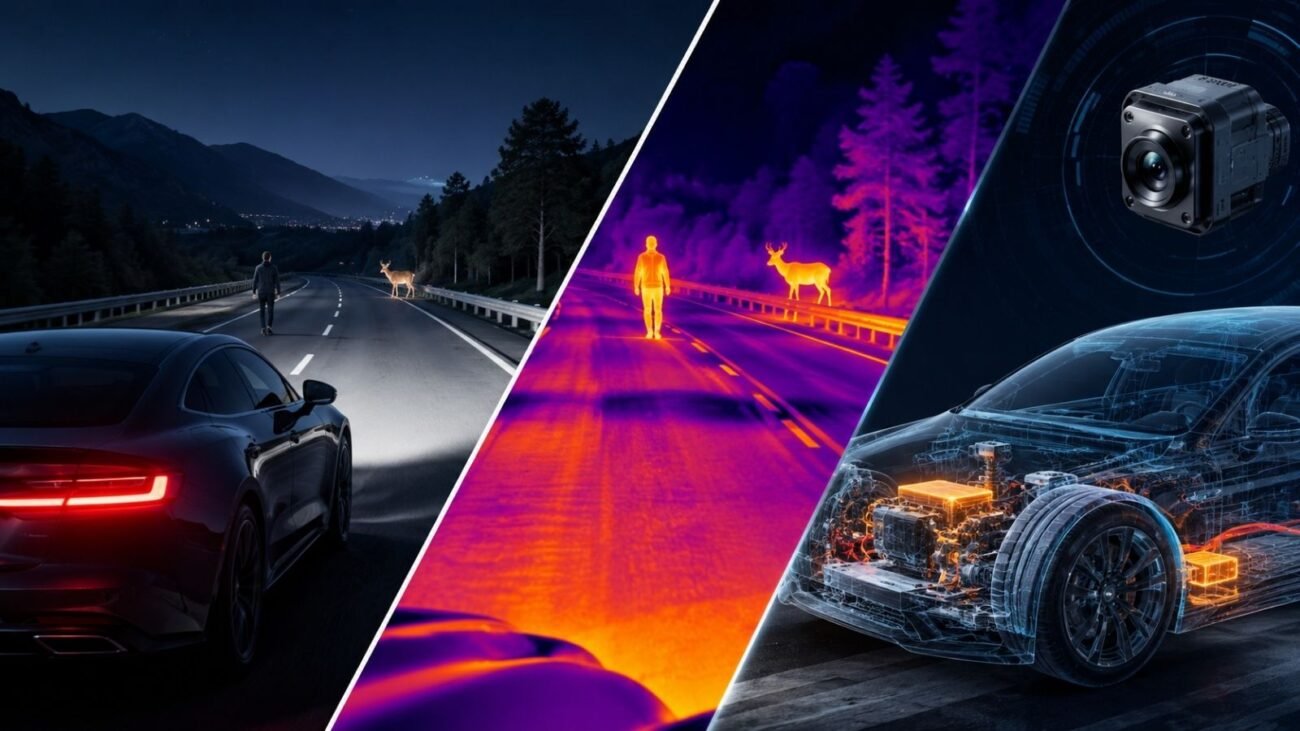
Unlike traditional cameras that rely on visible light, thermal imaging cameras detect infrared radiation emitted by objects, allowing vehicles to “see” pedestrians, animals, and other heat sources even in complete darkness.
This article explains how infrared thermal imaging works, why it is important in the automotive industry, and how it is shaping the future of intelligent transportation.
What Is Infrared Thermal Imaging?
Infrared thermal imaging is a technology that detects heat rather than visible light.
Every object above absolute zero continuously emits infrared radiation. The warmer the object, the stronger the infrared energy it emits.
A thermal imaging camera converts this invisible infrared radiation into an image where different temperatures appear as different colors or grayscale levels.
For example:
- Human body temperature is approximately 37°C.
- Vehicle engines often operate above 80°C.
- Exhaust systems may reach several hundred degrees Celsius.
- Tires become warmer after driving.
- Buildings, roads, and vegetation usually cool down significantly at night.
Unlike ordinary cameras, thermal imaging systems can clearly distinguish these temperature differences regardless of lighting conditions.
This unique capability makes infrared thermal imaging especially valuable for automotive applications.
Why Is Infrared Thermal Imaging Important for Modern Vehicles?
Modern vehicles rely on multiple sensors to understand their surroundings.
Typical automotive sensors include:
- Visible-light cameras
- Millimeter-wave radar
- LiDAR
- Ultrasonic sensors
- GPS
- Infrared thermal cameras
Each sensor has strengths and limitations.
Visible cameras perform well during daylight but struggle at night.
Millimeter-wave radar accurately measures distance but cannot easily identify object types.
LiDAR provides precise three-dimensional mapping but remains relatively expensive and may be affected by adverse weather.
Infrared thermal imaging complements these technologies by providing reliable heat detection regardless of ambient lighting.
This is why more manufacturers are integrating thermal cameras into multi-sensor fusion systems.
Key Advantages of Automotive Infrared Thermal Imaging
Excellent Night Vision Performance
One of the biggest advantages of thermal imaging is its ability to operate without visible light.
Whether driving on rural roads, highways, or mountain roads without streetlights, infrared cameras continue to detect pedestrians, cyclists, and animals that traditional cameras may miss.
For night driving, this significantly improves driver awareness and reaction time.
Improved Pedestrian Detection
Pedestrians are among the most vulnerable road users.
Because the human body naturally emits heat, thermal cameras can detect people wearing dark clothing or standing in poorly illuminated environments.
Many premium vehicles use thermal imaging together with AI algorithms to:
- Highlight pedestrians
- Trigger collision warnings
- Support Automatic Emergency Braking (AEB)
- Reduce nighttime accident risks
Wildlife Detection
Animal collisions remain a major safety concern in many countries.
Thermal imaging systems can detect:
- Deer
- Moose
- Wild boars
- Livestock
- Other large mammals
Even if these animals are partially hidden by vegetation, their body heat often remains visible through thermal cameras.
This gives drivers valuable extra reaction time.
Enhanced Autonomous Driving
Autonomous vehicles require reliable environmental perception under all weather and lighting conditions.
Thermal imaging improves perception by detecting heat signatures that may not be visible to standard cameras.
During nighttime or rainy conditions, thermal imaging can identify pedestrians long before visible cameras recognize them.
When combined with radar, LiDAR, and AI-based object recognition, thermal imaging significantly improves perception reliability.
Automotive Applications of Infrared Thermal Imaging
Night Vision Systems
Luxury vehicles increasingly include automotive night vision systems powered by infrared thermal cameras.
These systems display thermal images directly on the dashboard or head-up display, helping drivers identify hazards beyond the reach of headlights.
Advanced Driver Assistance Systems (ADAS)
Modern ADAS platforms increasingly integrate thermal imaging into functions such as:
- Forward Collision Warning
- Automatic Emergency Braking
- Pedestrian Detection
- Adaptive Cruise Control
- Driver Alert Systems
Thermal cameras provide an additional layer of environmental awareness, especially during nighttime driving.
Autonomous Vehicles
Self-driving vehicles require continuous environmental monitoring.
Thermal imaging supports autonomous driving by improving:
- Human detection
- Animal recognition
- Obstacle identification
- Nighttime navigation
- Low-light perception
As AI technology advances, thermal imaging is expected to become a standard sensor for autonomous vehicles.
Electric Vehicle Battery Monitoring
Electric vehicles require sophisticated thermal management.
Battery overheating may reduce lifespan or create safety risks.
Thermal imaging is widely used during:
- Battery development
- Thermal management optimization
- Manufacturing inspection
- Quality control
- Maintenance diagnostics
Engineers can quickly identify abnormal temperature distribution inside battery packs without physical disassembly.
Electric Motor Inspection
Electric motors generate heat during operation.
Thermal imaging helps engineers detect:
- Bearing wear
- Cooling failures
- Winding overheating
- Electrical imbalance
This enables predictive maintenance before failures occur.
Electrical System Diagnostics
Modern vehicles contain thousands of electrical connections.
Loose connectors or overloaded circuits often generate excessive heat.
Thermal imaging quickly identifies abnormal hot spots, reducing troubleshooting time.
Brake System Inspection
Brake components naturally become hot during braking.
However, uneven temperatures may indicate:
- Brake drag
- Sticking calipers
- Uneven brake pad wear
Thermal imaging provides immediate visual evidence of these issues.
Tire Inspection
Thermal cameras also help detect:
- Tire pressure problems
- Uneven tire wear
- Wheel bearing failures
- Suspension issues
This technology is widely used in commercial fleets and motorsports.
Infrared Thermal Imaging in Automotive Manufacturing
Thermal imaging plays an increasingly important role during vehicle production.
Welding Inspection
Engineers monitor welding temperatures to ensure consistent weld quality and structural integrity.
Paint Curing Inspection
Thermal cameras verify uniform heating during paint curing, helping prevent coating defects.
Component Reliability Testing
Manufacturers use thermal imaging during environmental testing, including:
- High-temperature testing
- Low-temperature testing
- Thermal cycling
- Durability evaluation
These tests improve long-term product reliability.
Challenges of Automotive Thermal Imaging
Despite its advantages, thermal imaging still faces several challenges.
Higher Cost
Although prices continue to decline, infrared detectors remain more expensive than conventional cameras.
Lower Resolution
Most thermal cameras have lower image resolution than visible-light cameras.
Therefore, they excel at detecting objects rather than identifying fine visual details.
Environmental Influences
Hot weather reduces temperature contrast between people and their surroundings.
Heavy rain, dense fog, and physical obstacles may also affect thermal imaging performance.
Dependence on Artificial Intelligence
Thermal images show heat patterns but cannot independently determine object categories.
AI algorithms combine thermal data with visible cameras, radar, and LiDAR for accurate recognition.
Future Trends of Infrared Thermal Imaging in the Automotive Industry
Several trends are driving the future of automotive thermal imaging.
Lower Manufacturing Costs
The mass production of uncooled infrared detectors is making thermal cameras increasingly affordable.
Higher Resolution Sensors
Advancements in detector technology continue improving image quality and detection range.
AI-Powered Thermal Imaging
Artificial intelligence will enhance thermal image analysis, enabling faster object recognition and better decision-making.
Greater Integration with Autonomous Driving
Future autonomous vehicles will rely on thermal imaging as a core perception technology for safe operation under all lighting conditions.
Growing Adoption in Electric Vehicles
As EV production expands worldwide, thermal imaging will become increasingly important for battery safety and predictive maintenance.
Frequently Asked Questions (FAQ)
Can infrared thermal imaging see through fog?
Thermal imaging generally performs better than visible-light cameras in light fog and smoke because it detects infrared radiation instead of visible light. However, very dense fog, heavy rain, or thick obstacles can still reduce its performance.
Can thermal cameras detect pedestrians at night?
Yes.
Detecting human body heat is one of the biggest advantages of thermal imaging. Many premium automotive night vision systems can identify pedestrians well beyond the range of standard headlights.
Is thermal imaging replacing LiDAR or radar?
No.
Modern intelligent vehicles increasingly rely on sensor fusion, combining cameras, radar, LiDAR, and thermal imaging to maximize safety and perception accuracy.
Are thermal cameras used in electric vehicles?
Absolutely.
Thermal imaging is widely used during EV battery development, manufacturing, quality inspection, predictive maintenance, and thermal management optimization.
Conclusion
Infrared thermal imaging is rapidly becoming one of the most valuable sensing technologies in the automotive industry.
From improving nighttime visibility and pedestrian detection to enhancing autonomous driving, electric vehicle safety, predictive maintenance, and manufacturing quality control, thermal imaging provides capabilities that conventional cameras cannot achieve.
Rather than replacing existing sensors, automotive infrared thermal imaging complements cameras, radar, and LiDAR through intelligent sensor fusion, creating safer and more reliable vehicles capable of operating in challenging environments.
As infrared detector technology continues to mature and costs continue to decrease, thermal imaging is expected to move beyond premium vehicles and become a mainstream feature in future intelligent automobiles. For automotive manufacturers, suppliers, and technology developers, investing in infrared thermal imaging is no longer just an innovation—it is becoming a strategic advantage in the next generation of mobility.