

Applications of Infrared Thermal Imaging Technology in Counter-UAS Systems
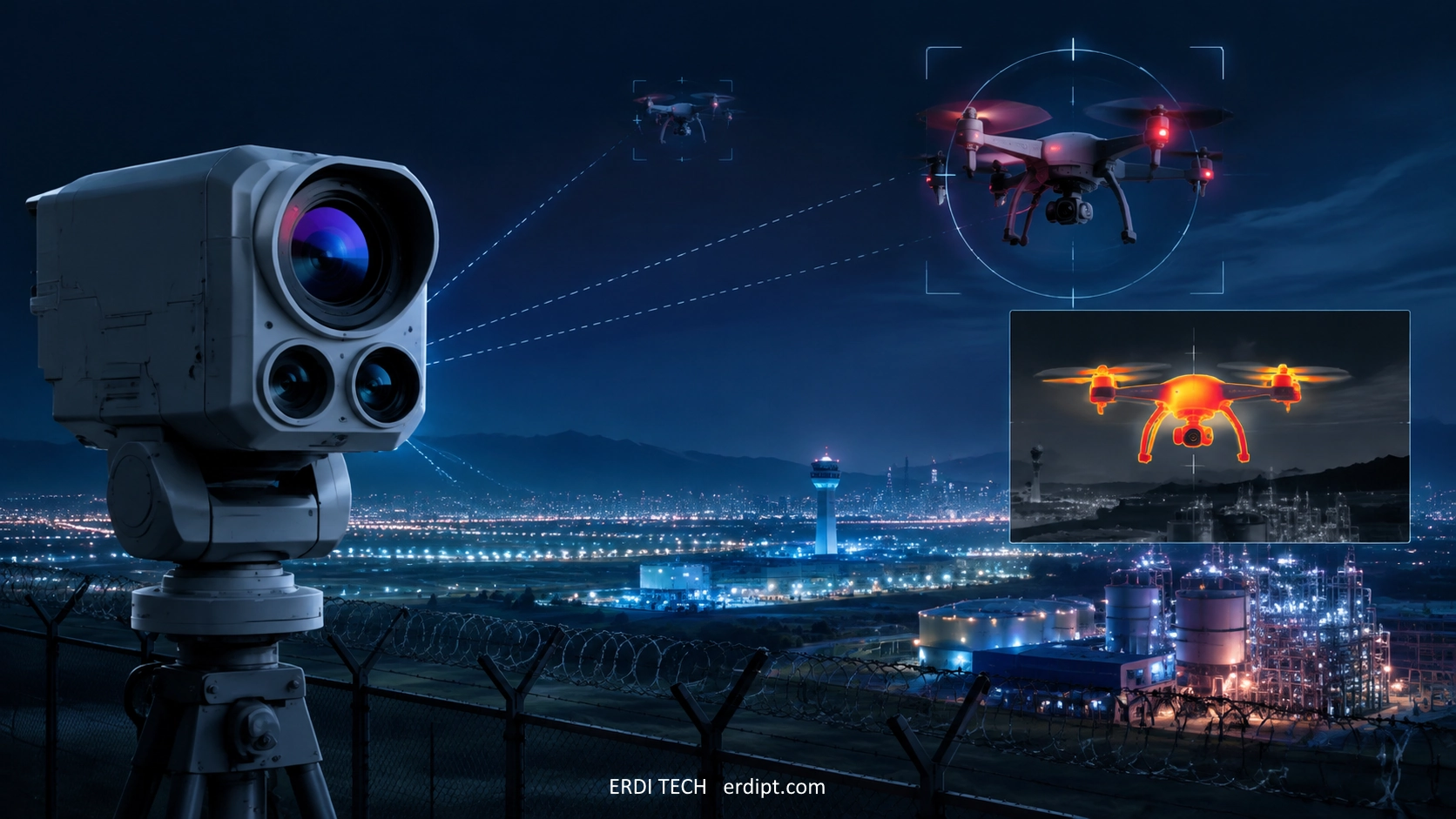
Introduction: New Security Challenges in the Era of Unmanned Aerial Vehicles
In recent years, unmanned aerial vehicle (UAV) technology has developed rapidly. With advantages such as compact size, low cost, flexible operation, and high mobility, small UAVs have been widely adopted in many civilian fields, including aerial photography, logistics, agriculture, infrastructure inspection, and surveying.
However, as UAV technology becomes increasingly accessible, potential security risks associated with unauthorized drone activities have attracted growing attention.
Unauthorized UAVs entering sensitive areas such as airports, military bases, power facilities, and government sites may create significant security threats. For example, drones can be used for illegal surveillance, carrying hazardous payloads, interfering with critical infrastructure, or conducting reconnaissance in high-risk environments.
As a result, detecting, identifying, tracking, and responding to unauthorized UAVs has become a critical requirement for modern security systems.
Traditional UAV detection methods mainly rely on radar, radio frequency (RF) detection, and visible-light cameras. However, as drones become smaller, fly at lower altitudes, and operate in increasingly complex environments, single-sensor solutions often face limitations.
Under these circumstances, infrared thermal imaging technology has emerged as an important component of Counter-Unmanned Aircraft Systems (C-UAS). Due to its all-weather operation capability, passive detection advantages, and sensitivity to thermal radiation, infrared imaging provides an effective solution for UAV detection and tracking.
By integrating infrared cameras with visible-light cameras, radar systems, and artificial intelligence algorithms, modern counter-drone systems can achieve more accurate and reliable detection and identification performance.
1. What Is Infrared Thermal Imaging Technology?
Before understanding the role of infrared thermal imaging in counter-UAS applications, it is important to understand its basic operating principle.
All objects with a temperature above absolute zero emit infrared radiation. Generally, the higher the temperature of an object, the stronger the infrared energy it radiates.
The human eye can only detect visible light, typically within the wavelength range of approximately 380 nm to 780 nm. Infrared radiation, however, belongs to an invisible part of the electromagnetic spectrum and cannot be directly observed by humans.
Infrared thermal imaging systems use specialized infrared detectors to capture infrared radiation emitted by objects. The detector converts this radiation into electrical signals, which are then processed to generate thermal images showing temperature distribution.
Unlike conventional cameras, infrared thermal imaging devices do not rely on external illumination. Instead, they detect the heat radiation naturally emitted by objects.
Therefore, infrared thermal cameras can operate effectively in conditions such as:
- Complete darkness;
- Low-light environments;
- Foggy conditions;
- Smoke-filled areas;
- Strong backlighting situations.
This unique capability makes infrared technology highly valuable in military applications, security monitoring, and counter-UAS systems.
2. Why Are UAVs Suitable Targets for Infrared Thermal Imaging Detection?
Many people may wonder:
“Small drones are difficult to see and move quickly. How can infrared systems detect them?”
Although UAVs are often small, they generate several noticeable heat signatures during operation.
2.1 Heat Generated by Motors
Most modern UAVs use electric propulsion systems.
During flight, electric motors rotate at high speeds to drive propellers, generating heat in the process. Motor temperatures can become especially noticeable during:
- High-speed flight;
- Long-duration hovering;
- Heavy payload operations;
- High-power operation.
These heat sources create detectable infrared signatures.
2.2 Heat Released by Batteries
Most UAVs are powered by lithium batteries.
During discharge, batteries generate heat, especially when supplying high power.
For medium and large UAVs, the battery compartment can become a significant infrared feature.
2.3 Heat Generated by Electronic Components
UAVs contain many electronic systems, including:
- Flight controllers;
- Image processing units;
- Communication modules;
- Navigation systems;
- Various sensors.
These components produce heat during operation.
Although the heat from individual components may be limited, together they can form recognizable thermal patterns when observed from a distance.
2.4 Temperature Contrast Between UAVs and Background
Infrared detection does not simply measure “hot objects.” Instead, it detects differences in infrared radiation between targets and their surroundings.
During flight, UAVs often create thermal contrast against backgrounds such as:
- The sky;
- Buildings;
- Trees;
- Terrain.
Even if a drone is not extremely hot, it may still be detected if there is sufficient temperature difference between the UAV and its environment.
3. Main Roles of Infrared Thermal Imaging in Counter-UAS Systems
A complete counter-UAS system usually includes several stages:
- Detection;
- Identification;
- Tracking;
- Threat assessment;
- Response.
Infrared thermal imaging plays a critical role in the first several stages.
3.1 All-Weather UAV Detection
The biggest limitation of visible-light cameras is their dependence on lighting conditions.
During daytime, visible cameras can provide clear images. However, their performance decreases significantly in:
- Nighttime environments;
- Low-light conditions;
- Strong backlight;
- Smoke or haze.
Infrared thermal imaging does not depend on visible illumination and can operate continuously day and night.
For example, in airport perimeter protection, infrared thermal cameras can continuously scan surrounding airspace. Once an abnormal thermal target is detected, the information can be transmitted to the security system for further analysis.
3.2 Long-Range Target Detection
Counter-UAS systems usually need to detect drones before they enter restricted areas.
Long-distance detection requires high-performance imaging systems.
The detection range of infrared systems depends on factors such as:
- Detector sensitivity;
- Lens focal length;
- Detector resolution;
- Target size;
- Ambient temperature;
- Atmospheric conditions.
High-performance infrared modules often use:
- Large-aperture infrared lenses;
- High-sensitivity detectors;
- High-resolution infrared sensors;
to improve long-range UAV detection capability.
3.3 Improved Identification Through Infrared and Visible-Light Fusion
Infrared images provide excellent thermal information, but sometimes they lack detailed visual features.
For example, birds, drones, and other flying objects may produce similar thermal patterns.
Therefore, advanced counter-UAS systems often combine two imaging technologies:
Infrared thermal imaging provides:
- Nighttime detection;
- Thermal target recognition;
- All-weather surveillance.
Visible-light cameras provide:
- Detailed target images;
- Visual confirmation;
- Human-assisted identification.
The combination of both sensors significantly improves recognition accuracy.
3.4 AI-Based Automatic Recognition
With the development of artificial intelligence, many counter-UAS systems now use AI algorithms to analyze infrared images.
AI systems can learn UAV thermal characteristics from large amounts of training data, including:
- Flight patterns;
- Heat distribution;
- Movement trajectories;
- Target size variations.
The system can automatically determine whether the detected object is:
“A UAV”
or:
“A bird”
or:
“Another moving thermal object.”
This reduces operator workload and improves response speed.
4. Applications of Infrared Thermal Imaging in Different Counter-UAS Scenarios
4.1 Military Base Protection
Military facilities represent one of the most important application areas for counter-UAS technology.
Unauthorized drones may be used for:
- Surveillance;
- Intelligence gathering;
- Target positioning;
- Airspace intrusion.
Military bases require:
- Continuous monitoring;
- Long-range detection;
- Rapid response capability.
Infrared thermal imaging systems can serve as an essential part of perimeter defense networks, working together with radar and RF detection systems to create multi-layer protection.
4.2 Airport Security
Airports are highly sensitive to low-altitude flying objects.
Unauthorized drones near airports can cause:
- Flight delays;
- Aviation safety risks;
- Airport operation disruptions.
Infrared thermal imaging systems can continuously monitor surrounding airspace, especially during nighttime operations.
Compared with conventional cameras, infrared systems provide significant advantages in dark environments and challenging weather conditions.
4.3 Protection of Energy Infrastructure
Large-scale energy facilities, including:
- Oil facilities;
- Natural gas stations;
- Power plants;
usually require high-level security protection.
Unauthorized drone activities may create serious risks.
Infrared thermal imaging can support:
- Perimeter surveillance;
- Airspace monitoring;
- Automatic threat alerts.
4.4 Border and Critical Area Monitoring
Border regions often cover large areas with complex environments.
Traditional patrol methods can be costly and inefficient.
Infrared thermal imaging combined with automated surveillance systems can provide:
- Long-duration unmanned monitoring;
- Nighttime target detection;
- Detection in complex environments.
4.5 Security Protection for Large Events
During major sporting events, international conferences, and public gatherings, low-altitude security becomes increasingly important.
Counter-UAS systems equipped with infrared thermal imaging can detect unauthorized drones in advance and support appropriate response measures.
5. Future Development Trends of Infrared Thermal Imaging in Counter-UAS Applications
As UAV technology continues to evolve, counter-UAS systems are also advancing rapidly.
Future infrared thermal imaging modules will develop toward several key trends.
5.1 Higher Resolution
Historically, infrared systems were mainly used in military applications and were relatively expensive.
With advances in detector technology, medium- and high-resolution infrared modules are becoming increasingly accessible.
Higher resolution enables:
- Longer detection distances;
- Clearer target details;
- More accurate identification.
5.2 Smaller Size and Lower Power Consumption
Counter-UAS equipment is increasingly moving toward:
- Portable systems;
- Vehicle-mounted platforms;
- UAV-mounted solutions.
Therefore, infrared modules need to achieve:
- Lower weight;
- Smaller dimensions;
- Lower power consumption.
5.3 Deeper Integration with Artificial Intelligence
Future systems will not only “see drones,” but also automatically:
- Detect targets;
- Classify objects;
- Track movement;
- Predict flight paths.
Artificial intelligence will play an increasingly important role in counter-UAS operations.
5.4 Multi-Sensor Fusion
Future counter-UAS systems will not rely on a single technology.
More advanced solutions will combine:
- Radar;
- Infrared thermal imaging;
- Visible-light cameras;
- RF detection;
- AI analysis.
By combining different technologies, overall reliability and detection accuracy can be greatly improved.
6. Key Parameters When Selecting Infrared Modules for Counter-UAS Applications
For counter-UAS systems, infrared module performance directly affects detection effectiveness.
Important parameters include:
6.1 Detector Resolution
Higher resolution provides more image details.
Common infrared resolutions include:
- 256×192;
- 384×288;
- 640×512;
- 1280×1024.
The appropriate resolution depends on the required detection distance and application requirements.
6.2 Spectral Range
Long-wave infrared (LWIR) is commonly used in counter-UAS applications.
Advantages include:
- All-weather capability;
- Strong environmental adaptability;
- Excellent thermal radiation detection performance.
6.3 NETD Thermal Sensitivity
NETD (Noise Equivalent Temperature Difference) indicates the detector’s ability to distinguish small temperature differences.
A lower NETD value means higher sensitivity.
High-sensitivity detectors can detect weaker thermal targets more effectively.
6.4 Lens Focal Length
The lens determines observation range and field of view.
Short focal length lenses:
- Provide wider viewing angles;
- Are suitable for searching.
Long focal length lenses:
- Provide longer detection distances;
- Are suitable for target tracking.
7. Limitations of Infrared Thermal Imaging
Although infrared thermal imaging provides significant advantages, it is not a perfect solution.
7.1 Extreme Weather Conditions
Heavy rain, snow, and high humidity may affect infrared radiation transmission.
7.2 Small Low-Heat Targets
Very small drones with limited heat output can still be challenging to detect.
7.3 Need for Multi-Technology Integration
Infrared imaging alone cannot complete all counter-UAS tasks.
Therefore, the future direction is multi-sensor cooperation rather than relying on a single technology.
Conclusion: Infrared Thermal Imaging Will Become a Key Technology for Low-Altitude Security
As UAV applications continue to expand, low-altitude security challenges are receiving increasing attention worldwide.
With advantages including:
- All-weather operation capability;
- Passive detection;
- High sensitivity to thermal targets;
- Easy integration with AI systems;
infrared thermal imaging technology is becoming a critical component of modern counter-UAS solutions.
In the future, improvements in infrared detector performance, cost reduction, and artificial intelligence development will further expand the role of infrared thermal imaging in military protection, airport security, energy infrastructure protection, and public safety.
For counter-UAS manufacturers, drone defense solution providers, and security system integrators, high-performance, compact, and intelligent infrared thermal imaging modules will become an essential technological foundation for building next-generation low-altitude security defense systems.
Featured Products