

Essential Considerations When Integrating an Infrared Thermal Imaging Module into Your System
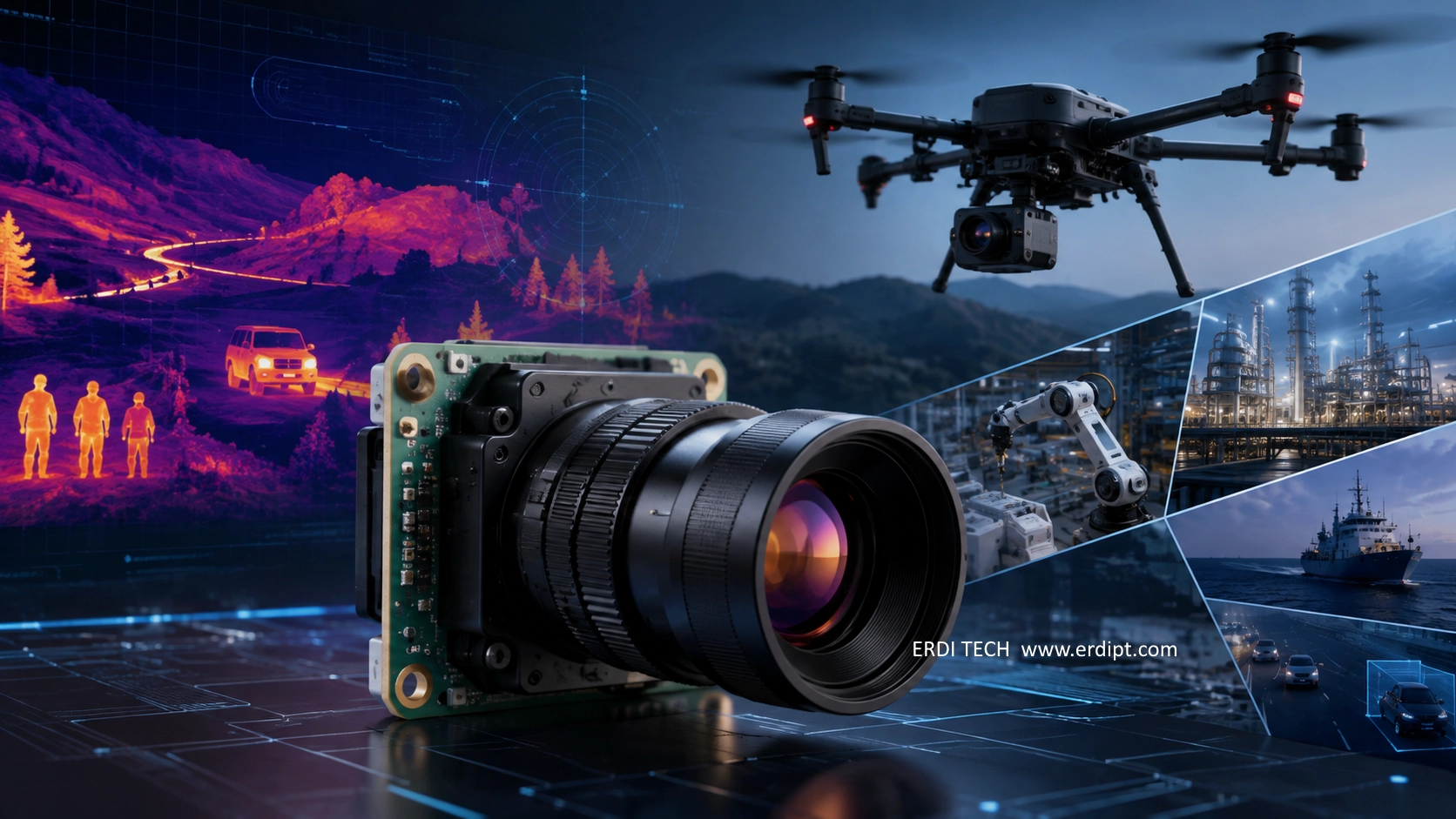
Quick answer: an infrared thermal imaging module is not a conventional camera — evaluate optics, detector, electronics, thermal design, interfaces, and environmental performance as one integrated system before you start.
Infrared thermal imaging technology is rapidly expanding beyond traditional applications such as military systems, security and surveillance, and industrial inspection. Today, thermal imaging modules are increasingly being integrated into UAVs, robotics, ADAS, firefighting systems, marine observation platforms, search and rescue equipment, and other intelligent vision systems.
For many system integrators, purchasing an infrared thermal imaging module may initially seem straightforward: choose the resolution, lens, interface, and price, then install the module into the system.
However, once integration actually begins, many engineers discover that an infrared thermal imaging module is not simply a conventional camera.
It involves optics, infrared detectors, electronics, image processing, mechanical design, power management, communication protocols, and environmental performance. Even if a thermal imaging module performs well when tested independently, problems may occur after it is installed into a UAV, robot, vehicle, or industrial system. Image quality may deteriorate, temperature measurements may become inaccurate, communication may become unstable, or the system may fail to start reliably.
For this reason, before integrating an infrared thermal imaging module, system designers should evaluate it from the perspective of the entire system, rather than focusing only on a few numbers in the product specification sheet.
This article explains the most important considerations when integrating
The optics side of that evaluation is easy to put numbers to with our free thermal imaging module selection calculator.
an infrared thermal imaging module and provides practical guidance to help engineers reduce integration problems during product selection, design, and testing.1. First Understand This: An Infrared Thermal Imaging Module Is Not a Conventional Camera
A conventional visible-light camera primarily receives visible light and uses a CMOS or CCD sensor to generate an image.
An infrared thermal imaging module, on the other hand, detects infrared radiation emitted by objects and converts differences in infrared radiation into thermal images related to the temperature distribution of the scene.
This means that infrared imaging systems have different requirements from conventional visible-light cameras.
For a visible-light camera, engineers may primarily consider:
- Resolution
- Frame rate
- Lens focal length
- Auto exposure
- Video interface
- Image format
For an infrared thermal imaging system, additional factors must be considered, including:
- Operating wavelength
- Detector type
- Pixel pitch
- Thermal sensitivity
- NETD
- Lens material
- Lens focal length
- Field of view
- Shutter or non-uniformity correction
- Temperature measurement capability
- Ambient temperature
- Thermal management
- Image processing algorithms
Therefore, infrared module specifications should always be evaluated in the context of the actual application rather than considered individually.
2. The First Question: What Kind of Thermal Image Does Your Application Actually Need?
Before selecting a module, ask yourself:
Do you need to detect a thermal target, or do you need to accurately measure its temperature?
These two requirements may appear similar, but they can require completely different products.
For example, an infrared module mounted on a UAV for nighttime search and rescue may primarily be used to detect people, vehicles, or other heat sources. In this case, the system may place greater emphasis on temperature contrast, detection distance, image clarity, field of view, and the ability to identify targets under low-light conditions.
By contrast, an industrial inspection system may need to determine whether a motor bearing has reached an abnormal temperature. In addition to detecting the heat source, the system may require accurate temperature measurement, a suitable temperature range, emissivity settings, and ambient temperature compensation.
In other words:
Being able to see a thermal target does not necessarily mean being able to measure its temperature accurately.
This is one of the most common issues overlooked by engineers who are integrating thermal imaging modules for the first time.
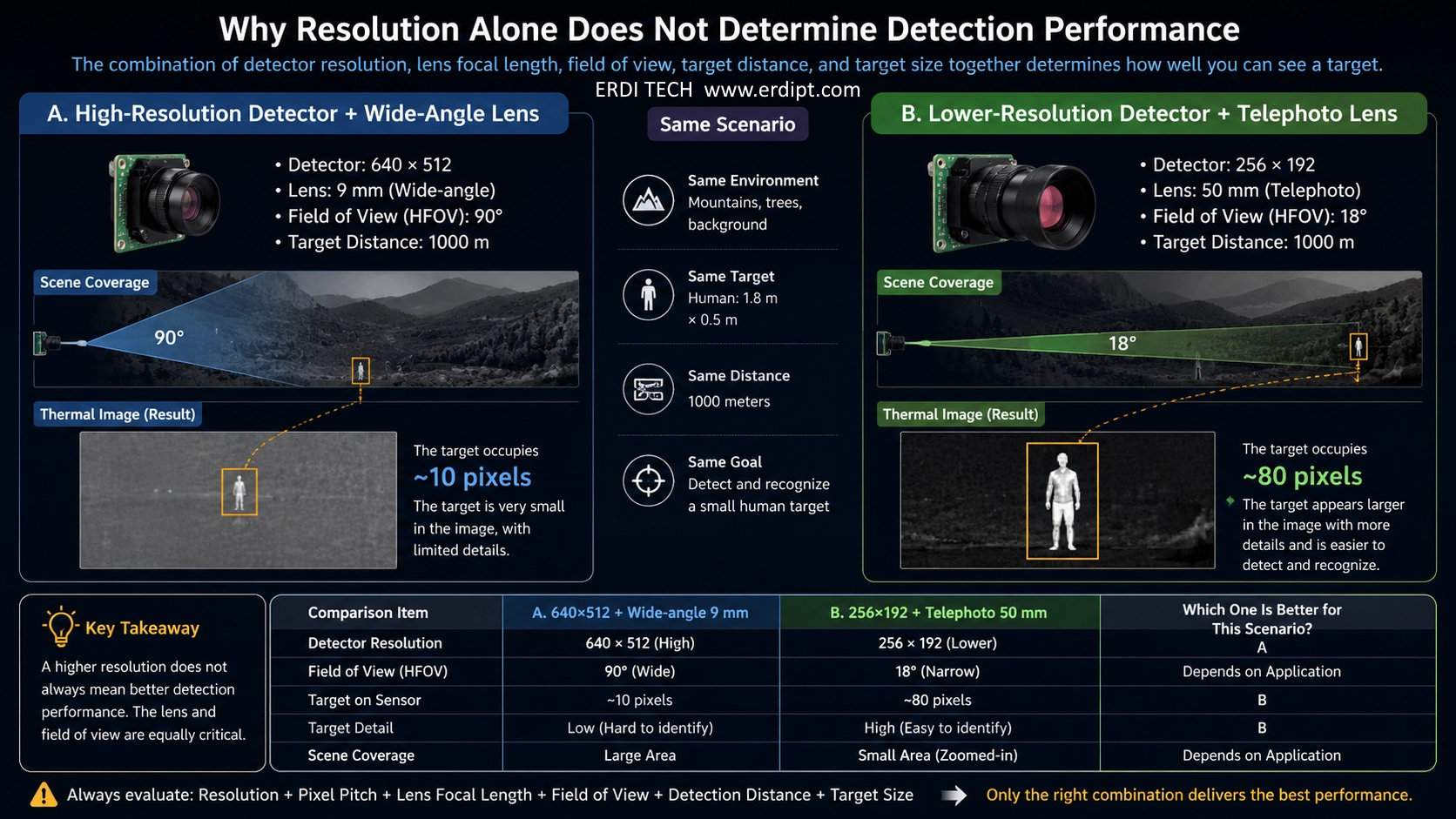
3. Resolution Is Important, But It Is Not the Only Factor
Common infrared thermal imaging resolutions include 160×120, 256×192, 320×256, 384×288, and 640×512.
When looking at a product specification sheet, it is natural to assume:
“640×512 must be better than 384×288, and 384×288 must be better than 256×192.”
A higher resolution generally provides more spatial information and can show more image detail. However, actual detection performance is not determined by resolution alone.
For example, a 256×192 infrared module equipped with an appropriate telephoto lens may be more suitable for a specific long-distance detection application than a 640×512 module equipped with a wide-angle lens.
The reason is the lens.
The ability of an infrared imaging system to detect a target depends on both the detector and the optical system.
Therefore, when selecting a module, the following parameters should be evaluated together:
Detector resolution + pixel pitch + lens focal length + field of view + detection distance + target size
This approach is much more meaningful than simply comparing whether a product has a 256×192 or 640×512 detector.
4. Lens Focal Length Determines How Far and How Wide You Can See
This is one of the most important considerations in infrared system integration.
Different lens focal lengths produce different fields of view.
Generally:
- Short-focal-length lenses provide a wider field of view and are suitable for observing larger areas.
- Medium-focal-length lenses provide a balance between viewing area and target size.
- Long-focal-length lenses provide a narrower field of view and are more suitable for observing distant targets.
For example, if a UAV is used for search and rescue, the system may need to search a large area for people. A lens with an excessively narrow field of view could reduce search efficiency.
However, if the system needs to identify a small target from a long distance, an excessively wide field of view could make the target occupy too few pixels in the image.
Therefore, a lens is not necessarily better simply because it is more expensive or has a longer focal length. It must match the target distance and target size.
5. Do Not Overlook the Material of the Infrared Lens
This is an important difference between infrared imaging systems and conventional visible-light imaging systems.
Conventional visible-light lenses commonly use optical glass and other materials. However, ordinary glass cannot effectively transmit many of the infrared wavelengths used by thermal imaging systems.
Therefore, infrared lenses generally need to use materials suitable for the corresponding infrared wavelength range.
For example, germanium is commonly used in many long-wave infrared optical systems.
This is one reason why infrared thermal imaging lenses can be considerably more expensive than conventional camera lenses.
At the same time, lens material, optical coating, transmission, focal length, and optical design all affect the final imaging performance.
Therefore, during system design, it should not be assumed that:
“As long as the interface and mounting dimensions are the same, I can simply replace the lens.”
In reality, the infrared lens and detector need to be optically matched.
6. NETD: A Lower Value Is Generally Better, But Context Still Matters
NETD, or Noise Equivalent Temperature Difference, is an important indicator of the thermal sensitivity of an infrared detector.
In simple terms, it describes the system’s ability to distinguish very small temperature differences.
Generally, a lower NETD means that the system can detect smaller differences in temperature.
For example, when identifying two targets with very similar temperatures, a system with lower NETD will generally have an advantage.
However, actual image quality cannot be judged by comparing NETD numbers alone.
Other factors may include:
- Detector performance
- Lens transmission
- Image processing algorithms
- Ambient temperature
- Calibration method
- Frame rate
- Gain control
- Temperature contrast within the scene
Therefore, NETD should be treated as an important performance indicator, but not as the only criterion for evaluating an infrared thermal imaging module.
7. Power Supply Requirements Are Often Underestimated
Sometimes, an infrared integration project fails not because of the thermal imaging technology itself, but because the power supply design was not properly considered.
When selecting a module, engineers should confirm:
- Input voltage
- Operating current
- Peak current
- Power consumption
- Startup current
- Power connector type
- Power stability requirements
This is especially important for UAVs, robots, and portable devices, where the available power capacity is already limited.
If the module requires a relatively high instantaneous current during startup and the system power supply does not provide sufficient margin, the system may experience:
- Failure to start
- Unexpected system restarts
- Sudden image loss
- Communication errors
- System crashes under high load
Therefore, it is recommended to obtain complete electrical specifications from the supplier during the system design stage rather than only checking whether the module uses “5V” or “12V” power.
8. Interface Compatibility Is More Than Simply Checking Whether an Interface Exists
Common interfaces used by infrared thermal imaging modules include USB, UART, RS-232, RS-485, Ethernet, MIPI, HDMI, and analog video.
However, even if two modules use the same interface, they may not be directly interchangeable.
For example, two modules may both use UART, but their:
- Baud rates
- Data formats
- Communication protocols
- Packet structures
- Checksum methods
- Control commands
may be completely different.
Therefore, before system integration, it is recommended to obtain the following from the supplier:
Communication protocol documentation, SDK, API documentation, and control command specifications.
This is particularly important for projects that require secondary software development.
9. Video Output Format Also Needs to Be Confirmed in Advance
If the thermal imaging module needs to connect to an embedded computing platform, engineers must confirm the video output format before purchasing the product.
Different modules may output:
- YUV
- RGB
- RAW
- H.264
- H.265
- MJPEG
- BT.656
- MIPI data streams
and other formats.
If the system uses an embedded computing platform such as an ARM-based system, NVIDIA Jetson platform, or another AI computing platform, it is necessary to confirm that the host platform can directly receive and process the module’s output.
Otherwise, a common situation may occur:
The thermal imaging module works perfectly, but the system cannot display the image.
Solving this problem may require drivers, an SDK, or an intermediate conversion program.
Therefore, interface compatibility should be confirmed before purchasing the module rather than after the hardware has already arrived.
10. Calibration Is Extremely Important for Infrared Thermal Imaging
Different pixels in an infrared detector do not always respond in exactly the same way.
Even when exposed to the same temperature target, different pixels may produce slightly different responses.
This can create fixed-pattern noise or non-uniformity in the thermal image.
For this reason, infrared systems generally require non-uniformity correction, commonly referred to as NUC.
Many thermal imaging modules use a shutter or another calibration mechanism to periodically correct detector response.
This is also why some thermal imaging devices may produce a short clicking sound, temporarily freeze the image, or rapidly adjust the image during operation.
For system integrators, it is important to confirm:
- What calibration method is used?
- Does the module use a mechanical shutter?
- Can calibration be triggered manually?
- Can the calibration interval be configured?
- Does video output pause during calibration?
- Can the host system control calibration externally?
These details are particularly important for applications that require continuous real-time observation.
11. Heat Generated by the Module Can Also Affect Imaging Performance
This is another issue that is easy to overlook.
Infrared modules contain detectors, processors, power-management components, and other electronic devices, all of which generate heat during operation.
If a module is installed inside a sealed enclosure, the internal temperature may gradually increase and affect the operating condition of the system.
This is particularly important for high-performance thermal imaging modules. Higher processing capability, higher frame rates, and more sophisticated image algorithms can also result in higher power consumption.
Therefore, the mechanical design should consider:
- Heat dissipation space
- Thermal conduction
- Installation orientation
- Enclosure material
- Ambient temperature
- Continuous operating time
A thermal imaging module should not simply be “put inside a box.”
If the equipment needs to operate continuously in a high-temperature environment, thermal testing should be performed in advance.
12. Mechanical Mounting Accuracy Can Also Affect Image Quality
Many engineers assume that the module only needs to be firmly mounted.
In reality, for UAVs, gimbals, robots, and other moving platforms, mechanical design can directly affect imaging performance.
For example, if the mounting structure has even slight mechanical looseness:
UAV vibration → slight module movement → image shake → reduced target detection performance
If an infrared module is combined with a visible-light camera to create a dual-sensor system, the optical alignment between the two cameras must also be considered.
If the system requires:
- Dual-spectrum image fusion
- Target tracking
- Picture-in-picture display
- Coordinate transformation
- AI target recognition
then the positional relationship between the two image streams becomes extremely important.
Therefore, mechanical mounting accuracy is not merely a structural issue. It is also an imaging issue.
13. UAV Applications Require Special Attention to Vibration and Weight
UAVs are one of the most typical applications for infrared thermal imaging modules.
However, UAV systems are different from fixed installations.
A UAV may experience:
- Motor vibration
- Propeller vibration
- Changes in flight attitude
- Power fluctuations
- Wind resistance
- Strict weight limitations
Therefore, selecting an infrared module for a UAV requires more than simply considering image quality.
Engineers should also consider:
Weight, dimensions, power consumption, interface, vibration resistance, and startup time.
If the module is too heavy, it increases the UAV payload and may reduce flight endurance.
If power consumption is too high, it may place an additional burden on the battery.
Therefore, UAV thermal imaging is essentially a comprehensive system optimization problem.
14. Environmental Performance Must Match the Actual Application
If the device is only used for laboratory testing, a commercial-grade thermal imaging module may be sufficient.
However, if the device will be installed on:
- UAVs
- Vehicles
- Ships
- Outdoor surveillance equipment
- Industrial robots
- Firefighting equipment
then environmental performance must be evaluated carefully.
Important specifications may include:
- Operating temperature
- Storage temperature
- Dust and water protection
- Vibration resistance
- Shock resistance
- Electromagnetic compatibility
Outdoor equipment may experience day-night temperature changes, rain, dust, and continuous vibration.
Therefore:
Excellent laboratory performance does not necessarily guarantee reliable performance after real-world deployment.
15. If Temperature Measurement Is Required, Understand the Difference Between Thermal Imaging and Temperature Measurement
This is one of the most important points in infrared system integration.
The colors displayed in a thermal image generally represent different levels of infrared radiation or temperature-related information. However, the color itself does not automatically represent an accurate absolute temperature.
Actual temperature measurement can also be affected by:
- Object emissivity
- Reflected ambient temperature
- Atmospheric distance
- Humidity
- Lens transmission
- Ambient temperature
- Surface material
For example, metal surfaces and human skin have different emissivity characteristics.
Therefore, if the system is intended for industrial temperature measurement, equipment condition monitoring, or fire temperature detection, the development team must clearly determine:
Does the application require qualitative thermal imaging or quantitative temperature measurement?
This decision directly affects module selection and software development.
16. Do Not Wait Until the Hardware Arrives to Start Software Integration
A common project workflow is:
Purchase module → Receive hardware → Connect it → Start studying the SDK
This approach can easily delay the project.
A better approach is to confirm the following with the supplier before purchasing:
- Is an SDK available?
- Which operating systems are supported?
- Is Windows supported?
- Is Linux supported?
- Is ARM supported?
- Is the target computing platform supported?
- Is an API available?
- Is sample code available?
- Is communication protocol documentation available?
- Can raw data be accessed?
If the project requires AI algorithms, it is also important to determine whether sufficient data interfaces are available.
An AI system may require more than a conventional video stream and may need access to lower-level image data.
17. Do Not Test Only the Module. Perform System-Level Testing
A thermal imaging module may perform very well in the supplier’s laboratory, but that does not necessarily mean it will deliver the same performance after being integrated into your product.
Effective testing should evaluate the complete system:
Thermal module + lens + host processor + power supply + mechanical structure + software + real-world environment
For example, a UAV project may require:
- Ground testing
- Static target testing
- Different-distance testing
- Daytime testing
- Nighttime testing
- Flight testing
- Vibration testing
- Long-duration operation testing
Only through system-level testing can many real integration problems be identified.
18. Ten Things to Confirm with Your Supplier Before Integrating a Thermal Imaging Module
If you are a system integrator, the following checklist can be sent directly to an infrared thermal imaging module supplier before purchasing.
1. Detector
Confirm:
- Resolution
- Pixel pitch
- Detector type
- Operating wavelength
- NETD
2. Lens
Confirm:
- Focal length
- Field of view
- Focusing method
- Fixed focus or autofocus
- Electric focus capability
3. Imaging
Confirm:
- Frame rate
- Image format
- Video output
- Pseudo-color modes
- NUC method
4. Temperature Measurement
Confirm:
- Whether temperature measurement is supported
- Measurement range
- Measurement accuracy
- Emissivity adjustment
- Area-based temperature measurement
5. Power
Confirm:
- Input voltage
- Power consumption
- Maximum current
- Connector type
6. Communication
Confirm:
- UART
- USB
- Ethernet
- RS-232/RS-485
- Other interfaces
7. Software
Confirm:
- SDK
- API
- Drivers
- Sample code
- Development documentation
8. Mechanical
Confirm:
- Dimensions
- Weight
- Mounting holes
- Installation orientation
- Lens interface
9. Environment
Confirm:
- Operating temperature
- Storage temperature
- Protection rating
- Vibration resistance
10. Customization
For volume projects, also confirm:
- OEM support
- Customized interfaces
- Customized lenses
- Customized mechanical structures
- Customized software functions
- MOQ
- Lead time
19. The Best Thermal Imaging Module Is the One That Fits Your System
Thermal imaging system integration is not simply about installing a module into a piece of equipment.
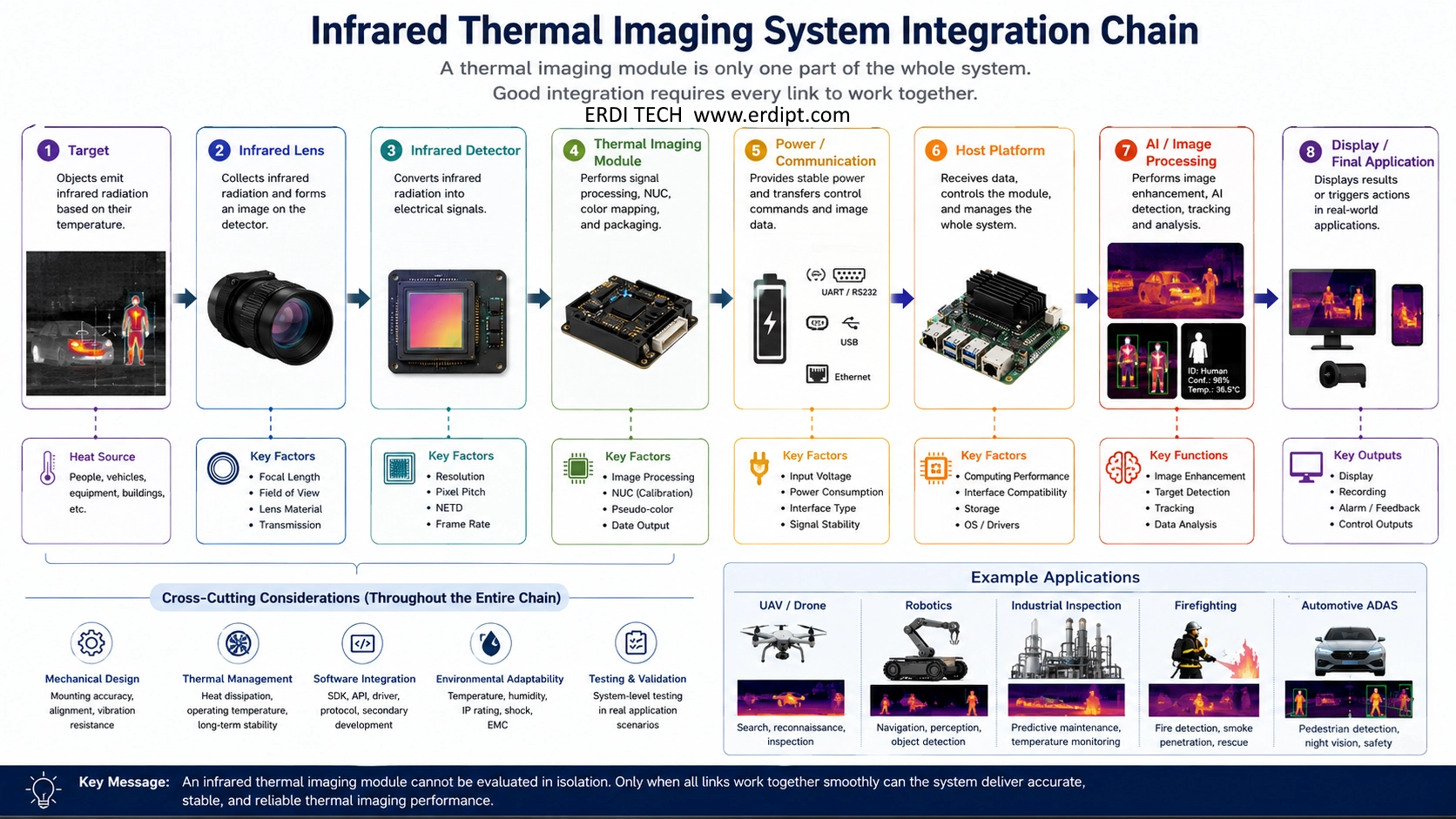
A complete infrared imaging system can be understood as a chain:
Target → Infrared radiation → Lens → Detector → Image processing → Data interface → Host processor → Display/AI analysis → Final application
Any problem at one stage can affect the final result.
Therefore, when selecting a thermal imaging module, you should not only ask:
“How much does this module cost?”
Nor should you only ask:
“What is the resolution?”
A more professional question is:
“Can this module meet the requirements of my system?”
These questions may differ by only a few words, but they represent completely different approaches to procurement and system design.
20. Conclusion: Move from “Buying a Module” to “Building a System”
As infrared thermal imaging technology becomes increasingly widespread, more and more system integrators will incorporate thermal imaging modules into their products.
For applications such as UAVs, robotics, security and surveillance, industrial inspection, firefighting, search and rescue, and automotive systems, the infrared module is usually only one core component of the overall system.
Successful thermal imaging integration therefore requires simultaneous consideration of optics, detectors, electronics, power supply, communication, mechanical design, software, and environmental conditions.
By addressing these issues early in the project, system integrators can significantly reduce the risk of problems such as:
- Interface incompatibility
- Power supply mismatch
- Unsuitable lenses
- Poor image quality
- Software integration difficulties
- Insufficient environmental performance
Ultimately, the goal is not to find the thermal imaging module with the highest specifications, but to find the module that is most suitable for your system, application scenario, and final objective.
For an infrared module supplier, the real value is not simply providing hardware that can generate a thermal image. It is helping customers establish the right match between the detector, lens, module, interface, software, and final application.
When system integrators and thermal imaging module suppliers communicate and evaluate requirements at the early stages of a project, infrared thermal imaging technology can move beyond being an isolated “component” and become a reliable visual capability within the complete product.
Featured Products