

Infrared Thermal Imaging Technology in Military Applications: Benefits, Uses, and Future Trends
Introduction
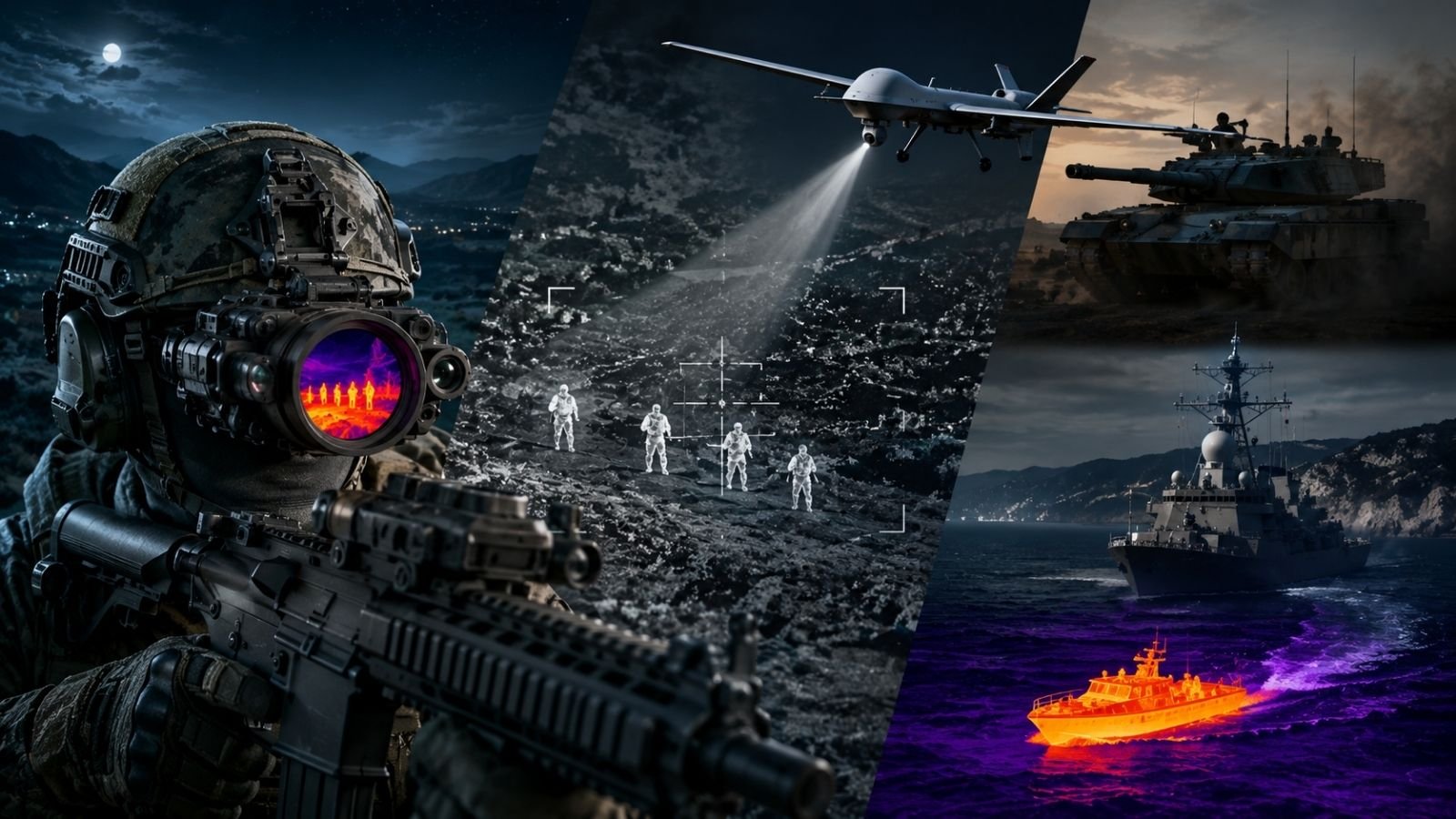
Infrared thermal imaging technology has become one of the most important sensing technologies in modern military operations.
Unlike conventional optical cameras, thermal imaging systems detect infrared radiation emitted by objects rather than relying on visible light. This allows military personnel to identify targets in complete darkness, through smoke, and in challenging weather conditions.
Today, thermal imaging technology is widely used in:
- Military surveillance
- Border security
- UAV reconnaissance
- Armored vehicles
- Fighter aircraft
- Naval systems
- Missile guidance
- Soldier equipment
As infrared detector technology continues to improve, thermal imaging has become a critical component of modern battlefield awareness.
This article explains how military thermal imaging works, where it is used, and why it has become indispensable for today’s defense systems.
What Is Infrared Thermal Imaging?
Infrared thermal imaging detects the heat naturally emitted by objects and converts temperature differences into visible images.
Unlike conventional cameras, thermal cameras do not require sunlight or artificial illumination.
They can operate effectively in:
- Complete darkness
- Smoke
- Fog
- Dust
- Camouflaged environments
Because every object with a temperature above absolute zero emits infrared radiation, thermal imaging systems can detect people, vehicles, aircraft, and equipment even when they are invisible to the naked eye.
Why Is Thermal Imaging Important in Modern Military Operations?
Modern warfare depends heavily on information superiority.
One of the greatest tactical advantages is detecting an opponent before being detected.
Thermal imaging significantly improves battlefield awareness by enabling military personnel to locate heat-emitting targets under conditions where traditional optical systems become ineffective.
Major benefits include:
- 24/7 surveillance capability
- Passive target detection
- Improved battlefield awareness
- Enhanced target acquisition
- Increased mission success rates
Military Applications of Infrared Thermal Imaging
1. Soldier Night Vision Systems
Modern soldiers increasingly rely on thermal weapon sights and handheld thermal monoculars.
Unlike traditional night vision devices, thermal imaging detects body heat directly.
Applications include:
- Night patrols
- Urban combat
- Border security
- Counter-terrorism operations
- Special forces missions
2. Main Battle Tanks
Thermal imaging plays a central role in modern tank fire-control systems.
Benefits include:
- Long-range target acquisition
- Nighttime combat capability
- Smoke penetration
- Faster target recognition
- Improved first-shot accuracy
Thermal imaging enables tank crews to detect enemy vehicles concealed by vegetation or terrain.
3. Military UAV Reconnaissance
Military drones increasingly integrate thermal imaging payloads.
Thermal cameras provide:
- Day and night surveillance
- Detection of hidden personnel
- Vehicle tracking
- Border monitoring
- Battlefield intelligence gathering
Combined with AI-powered image analysis, UAV thermal imaging significantly enhances reconnaissance efficiency.
4. Fighter Aircraft and IRST Systems
Many modern fighter aircraft employ Infrared Search and Track (IRST) systems.
Unlike radar, IRST systems are passive sensors that do not emit detectable radio signals.
Advantages include:
- Long-range aircraft detection
- Passive target tracking
- Reduced electronic signature
- Improved survivability
IRST technology has become an increasingly important complement to radar systems.
5. Missile Guidance Systems
Many air-to-air and surface-to-air missiles utilize infrared guidance.
Rather than detecting reflected radar signals, these missiles track thermal signatures generated by:
- Aircraft engines
- Vehicle engines
- High-temperature components
Modern infrared seekers feature:
- Higher sensitivity
- Better target discrimination
- Stronger resistance to countermeasures
6. Naval Surveillance Systems
Thermal imaging is widely deployed aboard naval vessels.
Typical applications include:
- Detecting small boats
- Coastal surveillance
- Harbor security
- Search and rescue
- Maritime patrol
Thermal imaging enhances operational capability during nighttime and poor weather.
7. Border Security
Thermal imaging systems have become standard equipment in many border surveillance networks.
Advantages include:
- Continuous 24-hour monitoring
- Detection of illegal crossings
- Long-range observation
- Automatic alarm integration
Many fixed surveillance towers combine thermal cameras with radar and visible-light cameras for comprehensive monitoring.
8. Military Equipment Maintenance
Thermal imaging is also valuable for predictive maintenance.
Military technicians use thermal cameras to identify:
- Engine overheating
- Electrical faults
- Hydraulic failures
- Mechanical wear
- Abnormal component temperatures
Early detection reduces maintenance costs and improves equipment readiness.
Advantages of Thermal Imaging in Military Operations
Compared with traditional optical systems, thermal imaging provides several key advantages.
Works Day and Night
Thermal cameras operate independently of visible light.
Detects Camouflaged Targets
Heat signatures often remain visible even when visual camouflage is effective.
Performs in Adverse Weather
Thermal imaging maintains operational capability in smoke, fog, and dusty environments.
Passive Detection
Unlike radar, thermal imaging does not emit detectable signals.
Supports Multiple Military Platforms
Thermal imaging is suitable for:
- Soldiers
- Tanks
- UAVs
- Aircraft
- Ships
- Ground vehicles
Limitations of Military Thermal Imaging
Despite its advantages, thermal imaging also has limitations.
Cannot See Through Solid Objects
Thermal cameras cannot see through walls or metal structures.
Reduced Performance in Low Thermal Contrast
When target and background temperatures are very similar, target detection becomes more challenging.
Limited Visual Detail
Thermal imaging shows temperature differences rather than true colors or fine visual details.
For this reason, many military systems combine thermal cameras with daylight optical sensors.
Future Trends in Military Thermal Imaging
Military infrared technology continues evolving rapidly.
Future developments include:
- Higher detector resolution
- AI-assisted target recognition
- Multi-sensor image fusion
- Longer detection distances
- Smaller and lighter systems
- Lower power consumption
- Integration with laser rangefinders
- Autonomous target tracking
These innovations will further improve battlefield awareness and operational effectiveness.
Frequently Asked Questions (FAQ)
What is military thermal imaging?
Military thermal imaging uses infrared sensors to detect heat emitted by objects, allowing personnel to identify targets regardless of lighting conditions.
Can thermal imaging work in complete darkness?
Yes.
Because thermal imaging detects heat instead of visible light, it functions effectively in total darkness.
Is thermal imaging better than night vision?
They serve different purposes.
Night vision amplifies available light, while thermal imaging detects heat.
Many military systems combine both technologies.
Why do military drones use thermal cameras?
Thermal cameras help drones detect personnel, vehicles, and other targets during day or night while improving reconnaissance capabilities.
Can thermal cameras see through walls?
No.
Thermal cameras detect surface temperatures and cannot see through solid walls or metal barriers.
Conclusion
Infrared thermal imaging has become one of the most critical technologies in modern defense systems.
From soldier equipment and armored vehicles to UAV reconnaissance, naval surveillance, missile guidance, and fighter aircraft, thermal imaging significantly enhances target detection, battlefield awareness, and operational effectiveness.
As infrared detector performance, artificial intelligence, and multi-sensor fusion technologies continue advancing, thermal imaging will remain an essential capability for future military platforms.
Whether used for surveillance, reconnaissance, target acquisition, or equipment maintenance, infrared thermal imaging continues to redefine how modern armed forces operate in complex battlefield environments.