

The Difference Between Night Vision Devices and Thermal Imaging Cameras
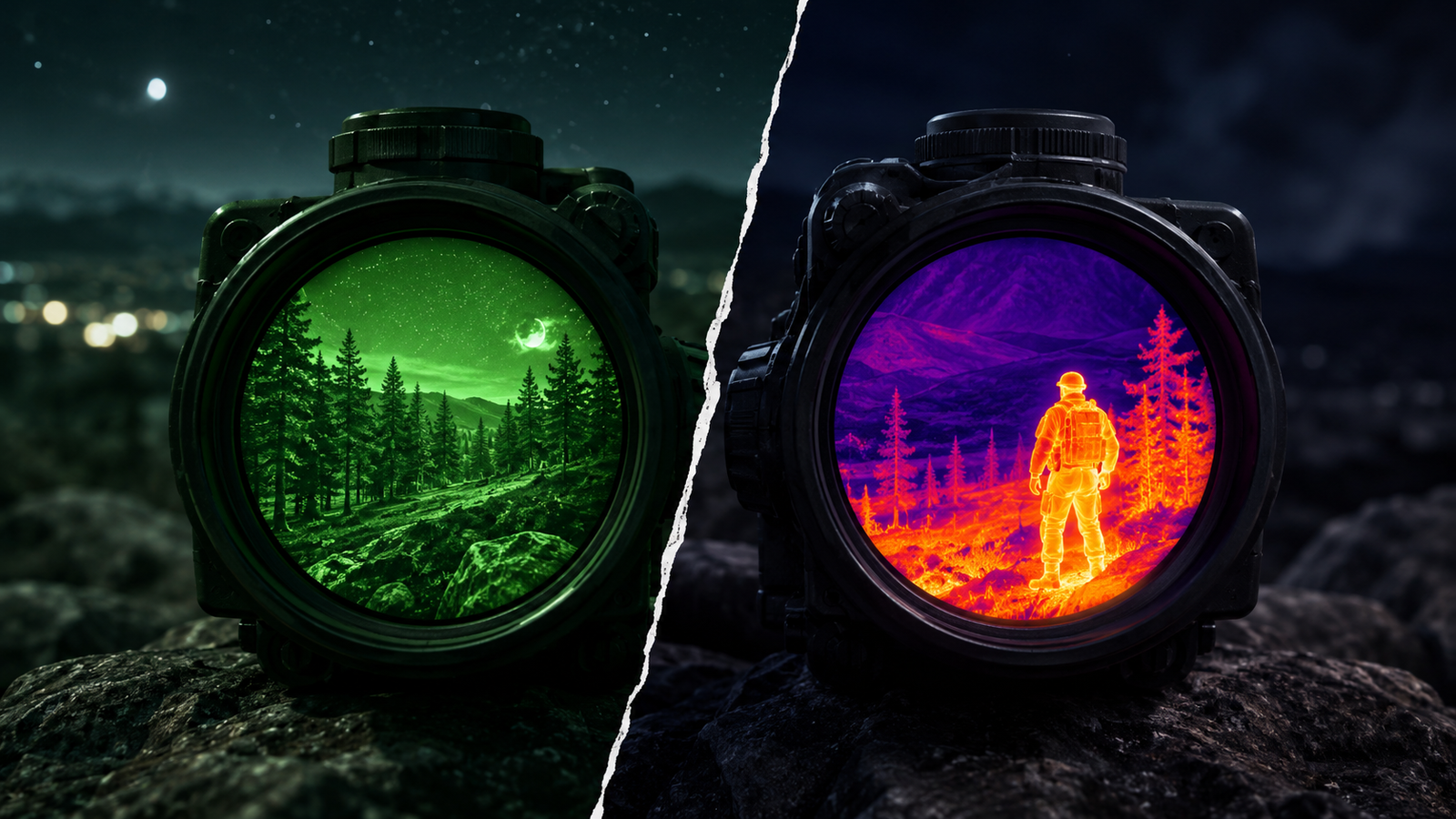
Quick answer: night vision amplifies existing light and fails in total darkness, while thermal imaging detects heat and works in complete darkness, smoke, and fog — for true all-weather night operation, thermal imaging is the more capable technology.
In movies, documentaries, and military-themed films, we often see scenes like this: soldiers wearing devices with green-colored displays that allow them to see clearly in complete darkness, while another type of device shows people and objects as glowing red or yellow heat signatures, even through darkness or smoke. Many people casually refer to both as “night vision equipment,” and some even assume they are the same thing.
In reality, night vision devices and thermal imaging cameras are completely different technologies. Although both help humans see in low-light or nighttime environments, their operating principles, imaging methods, strengths, weaknesses, and applications are very different.
Simply put:
Night vision devices amplify tiny amounts of existing light.
Thermal imaging cameras detect heat.
This article will explain the differences between the two technologies in simple, easy-to-understand language for general readers.
1. Why Humans Cannot See Well at Night
Before understanding these technologies, we first need to understand why human vision becomes poor in darkness.
Humans see objects because light reflects off surfaces and enters our eyes. During the daytime, sunlight provides abundant illumination, making objects easy to see.
At night, however, visible light becomes extremely limited. Since the eyes receive far less light, the surrounding world appears dim and blurry. In complete darkness, humans can barely see anything at all.
Night vision devices and thermal imaging cameras were both developed to overcome this natural limitation of human vision.
However, they solve the problem in two entirely different ways.
2. Night Vision Devices: Amplifying Tiny Amounts of Light
The core idea behind night vision technology is simple:
“As long as there is even a little light, it can be amplified.”
This light does not only refer to artificial lighting. It also includes:
Moonlight
Starlight
Reflected city light
Natural background light from the sky
Even in environments that appear completely dark to humans, there is often still a small amount of available light.
Night vision devices collect this extremely weak light and electronically amplify it thousands or even tens of thousands of times, allowing the human eye to see the environment again.
3. Why Are Most Night Vision Images Green?
Many people wonder why traditional night vision displays usually appear green.
The reasons are actually quite practical.
Human Eyes Are Highly Sensitive to Green
The human eye can distinguish more shades of green than many other colors. This makes green displays useful for recognizing shapes, textures, and details.
Green Causes Less Eye Fatigue
Bright white displays can become tiring during prolonged viewing. Green is easier on the eyes while still providing good contrast and clarity.
Today, some advanced night vision systems use “white phosphor” displays, which produce a black-and-white image that looks more natural.
4. Night Vision Devices Cannot Always See in Complete Darkness
Movies often create the impression that night vision devices can see perfectly in total darkness.
In reality, traditional night vision systems still require some amount of ambient light.
In places such as:
Underground tunnels
Sealed rooms
Deep caves
Extremely dark wilderness areas
there may not be enough light for the device to function properly.
To solve this problem, many night vision systems include infrared illuminators.
These work somewhat like flashlights, except they emit infrared light instead of visible light. Humans cannot see this infrared light, but night vision devices can use it for illumination.
However, this creates another issue:
Anyone else using night vision equipment may also detect the infrared light source.
5. Thermal Imaging Cameras: Seeing Heat Instead of Light
If night vision devices amplify light, thermal imaging cameras do something very different:
They detect heat.
In nature, any object above absolute zero emits infrared radiation.
Humans emit heat.
Animals emit heat.
Vehicle engines emit heat.
Even walls, rocks, and water surfaces release varying amounts of thermal energy.
Thermal imaging cameras detect this infrared radiation and convert temperature differences into visible images.
This is why thermal images often show:
Humans as bright figures
Engines as glowing hot spots
Pipes and machinery with distinct temperature patterns
The camera is essentially visualizing heat.
6. Thermal Imaging Does Not Depend on Light
This is one of the biggest advantages of thermal imaging technology.
Thermal cameras can operate in:
Complete darkness
Moonless environments
Smoke-filled areas
Some foggy conditions
because they do not rely on visible light.
Instead, they detect the heat naturally emitted by objects.
Even in total darkness, a warm object may still be clearly visible.
7. Why Thermal Images Use Strange Colors
Thermal images often appear in unusual colors such as:
Red
Yellow
Blue
Purple
These are not the object’s real colors.
They are called “false colors” or “pseudo colors.”
Since infrared radiation is invisible to the human eye, the camera must convert temperature data into visible colors.
Typically:
Warmer areas appear brighter
Cooler areas appear darker
Different devices may offer different display modes, including:
White-hot mode
Black-hot mode
Rainbow mode
Iron-red mode
These color schemes are designed to make temperature differences easier to interpret.
8. The Biggest Difference Between the Two Technologies
The simplest way to summarize the difference is:
Night vision sees light.
Thermal imaging sees heat.
This is the fundamental distinction between them.
More specifically:
| Feature | Night Vision | Thermal Imaging |
|---|---|---|
| Works By | Amplifying light | Detecting heat |
| Needs Light | Yes | No |
| Works in Total Darkness | Limited | Yes |
| Image Style | More natural-looking | Heat-based image |
| Detail Visibility | Usually better | Usually lower |
| Detecting Hidden Targets | Moderate | Excellent |
| Sensitive to Bright Light | Yes | Less affected |
| Cost | Usually lower | Usually higher |
9. They See the World in Completely Different Ways
Night Vision Feels More Natural
Night vision devices allow users to see:
Trees
Roads
Buildings
Terrain
Shapes and outlines
The overall image resembles what humans normally see.
This makes night vision especially useful for:
Walking
Driving
Navigation
Patrol operations
because the environment appears more familiar.
Thermal Imaging Excels at Finding Targets
Thermal imaging is especially powerful for detecting hidden objects.
For example:
A person hiding in bushes may be difficult to spot with the naked eye or even with night vision equipment.
But a thermal camera can often quickly reveal the person’s body heat.
This makes thermal imaging highly valuable for:
Search and rescue
Security
Hunting
Border surveillance
10. Why Thermal Cameras Can Sometimes See Through Smoke
Visible light is easily scattered by smoke, which is why human vision becomes poor in smoky environments.
Certain infrared wavelengths can penetrate smoke more effectively, allowing thermal cameras to continue detecting heat sources under some conditions.
However, thermal imaging is not “X-ray vision.”
It cannot see through everything.
Materials such as:
Thick walls
Metal plates
Heavy insulation
usually block thermal imaging.
Many people mistakenly believe thermal cameras can see through walls, but this is generally false.
11. Why Thermal Cameras Often Cannot See Through Glass
This surprises many first-time users.
Night vision devices can usually see through glass normally.
Thermal cameras often cannot.
This is because ordinary glass blocks much of the infrared radiation used in thermal imaging.
As a result, the camera mainly detects the temperature of the glass surface itself rather than objects behind it.
12. Why Modern Military Systems Use Both Technologies
The reason is simple:
Each technology has different strengths.
Advantages of Night Vision
More natural image
Better environmental detail
Easier for movement and navigation
Better depth perception
Advantages of Thermal Imaging
Excellent target detection
Works in complete darkness
Detects hidden or camouflaged targets
Easier to identify humans and animals
Modern systems increasingly combine both technologies into “fused imaging” systems that provide environmental detail together with heat detection.
13. Civilian Applications Are Expanding Rapidly
Many people assume these technologies are only used by the military.
In fact, both are now widely used in civilian industries.
14. Common Civilian Uses of Night Vision
Outdoor Activities
Examples include:
Camping
Hiking
Wildlife observation
Security Patrols
Night vision devices are commonly used by security personnel.
Marine Navigation
Some boats use night vision systems to improve nighttime visibility.
15. Thermal Imaging Has Even Broader Civilian Applications
Electrical Inspection
Loose electrical connections generate heat.
Thermal cameras can identify overheating components before failures occur.
Building Inspection
Thermal imaging can reveal:
Heat leaks
Poor insulation
Water leaks
Air conditioning problems
Search and Rescue
Rescue teams often use thermal imaging to locate missing people, especially at night or in mountainous regions.
Medical Assistance
Some medical applications use thermal imaging to observe temperature patterns on the human body.
Wildlife Observation
Animals hidden in vegetation can often still be detected through their body heat.
16. Why Thermal Imaging Cameras Are Usually More Expensive
There are several reasons.
More Complex Sensors
Thermal detectors are difficult and expensive to manufacture.
Advanced Image Processing
Thermal systems must process temperature data in real time and convert it into visible images.
Historically Restricted Technology
For many years, advanced thermal imaging technology was tightly controlled and expensive.
Although prices have decreased significantly in recent years, high-performance systems are still costly.
17. Future Trends: Fusion and Artificial Intelligence
Night vision and thermal imaging technologies are increasingly being combined.
Future systems may include:
Low-light enhancement
Thermal imaging
AI recognition
Automatic target tracking
Distance measurement
Image fusion
In other words, devices will not only help users “see,” but also help analyze what they are seeing.
For example:
Automatically identifying people
Detecting abnormal heat sources
Recognizing vehicles
Many of these capabilities are already becoming common.
18. A Simple Way to Understand the Difference
You can think of these technologies as two completely different senses.
Night Vision Is Like a “Super Eye”
It still depends on light, but it amplifies tiny amounts of it.
The resulting image is relatively close to normal human vision.
Thermal Imaging Is Like a “Heat Sensor”
It does not care about color or brightness.
It only cares about heat.
That is why it is so effective at detecting living creatures and operating machinery.
19. Which Technology Is Better?
People often ask:
“Which one is more advanced?”
The truth is that neither is universally better.
They are designed for different purposes.
If you need:
Navigation
Environmental awareness
Detailed terrain visibility
night vision is often better.
If you need:
Target detection
Finding hidden people or animals
Operation in total darkness
thermal imaging is usually superior.
That is why advanced systems increasingly combine both rather than replacing one with the other.
20. Conclusion
From military origins to modern use in security, construction, electrical inspection, outdoor activities, industrial maintenance, and rescue operations, night vision and thermal imaging technologies are becoming increasingly important in everyday life.
Although both help humans see in darkness, they represent two fundamentally different technological approaches:
One enhances faint light.
The other visualizes heat itself.
As sensors, artificial intelligence, and image processing technologies continue to improve, future night vision and thermal imaging systems will become smaller, smarter, and more affordable.
What once seemed like science fiction may soon become as common in daily life as smartphones are today.
Featured Products