

Principles of Lunar Laser Ranging Experiments — How Humanity Measures the Distance Between Earth and the Moon with a Beam of Light
Throughout the history of space exploration, many experiments that appear simple on the surface have carried enormous scientific significance. For example, if someone asks, “How far is the Moon from Earth?” most people would immediately answer: about 380,000 kilometers.
But the more important question is this:
How do scientists know that distance so precisely?
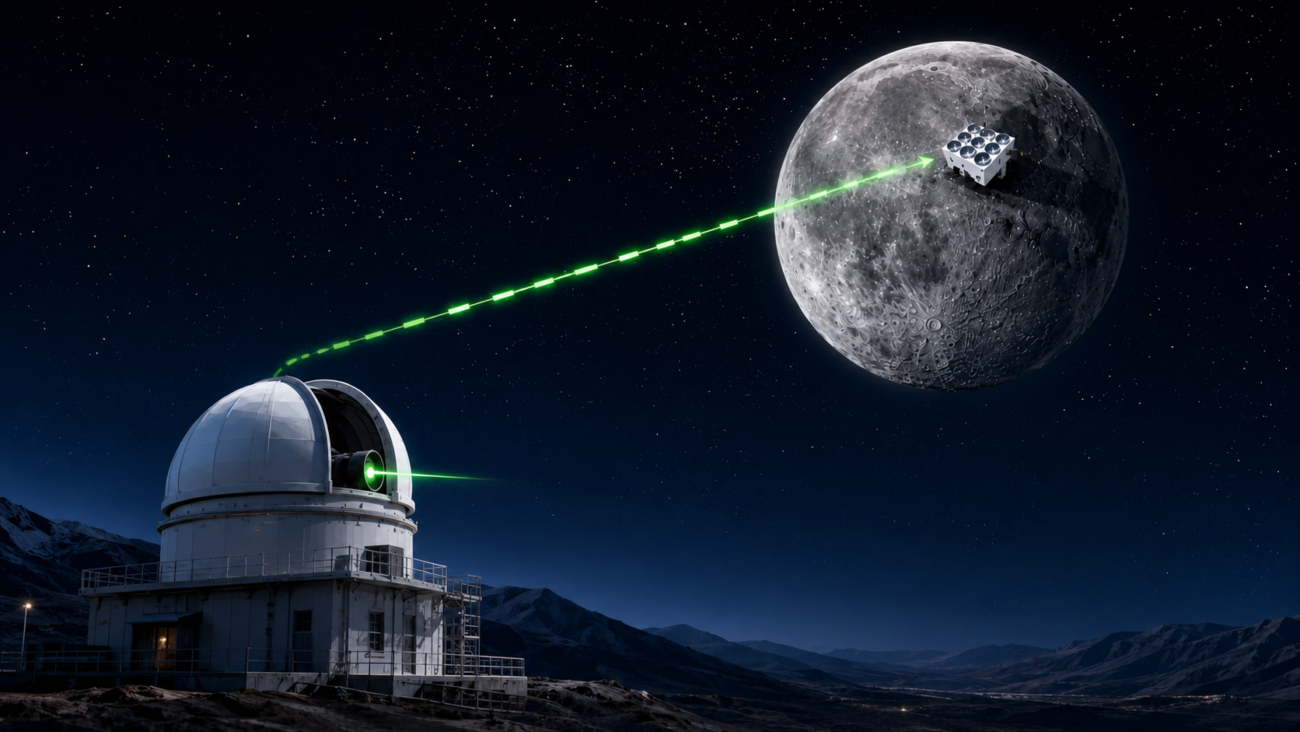
One of the answers lies in the famous Lunar Laser Ranging Experiment (LLR). The principle is surprisingly straightforward: scientists fire a laser beam from Earth toward the Moon, wait for it to reflect off mirrors placed on the lunar surface, and then measure the time it takes for the light to return. Since the speed of light is constant, the Earth–Moon distance can be calculated with extraordinary accuracy.
Although the idea sounds simple, the actual implementation involves some of the most advanced technologies in modern science, including laser engineering, celestial mechanics, relativity, ultra-precise timing systems, and space engineering.
Today, let us explore this remarkable scientific experiment that has continued for more than half a century.
1. Why Measure the Distance to the Moon?
The Moon is Earth’s nearest natural celestial neighbor and the first extraterrestrial body ever visited by humans. For decades, scientists have wanted to understand the exact dynamical relationship between Earth and the Moon.
Accurate measurements of the Earth–Moon distance help scientists study:
Variations in the Moon’s orbit
Changes in Earth’s rotation speed
Tidal interactions between Earth and the Moon
Motion of Earth’s tectonic plates
The accuracy of General Relativity
Possible deviations in gravitational theory
The Moon’s internal structure and evolution
In other words, measuring the Moon’s distance is not merely an astronomy problem—it is deeply connected to modern physics and Earth science.
Before laser technology existed, scientists relied mainly on astronomical observations and radar measurements, but their precision was limited. A major breakthrough came during the 1960s with the development of laser technology.
2. A Scientific Legacy of the Apollo Missions
On July 20, 1969, humans successfully landed on the Moon for the first time. During the historic Apollo 11 mission, astronauts Neil Armstrong and Buzz Aldrin carried out a seemingly modest yet extremely important task: they installed a laser reflector array on the lunar surface.
This device is not an ordinary mirror. It is called a Corner Cube Reflector.
The reflector is made from specially designed prisms with a unique property:
No matter what angle the incoming laser arrives from, it reflects directly back toward its source.
This means that even though both Earth and the Moon are constantly moving, the reflected laser can still return close to the original location on Earth.
Later Apollo missions, including Apollo 14 and Apollo 15, placed additional reflector arrays on the Moon. Soviet lunar rovers Lunokhod 1 and Lunokhod 2 also deployed similar devices.
Remarkably, many of these reflectors are still functioning today.
That means equipment placed on the Moon more than fifty years ago is still contributing to cutting-edge scientific research.
3. The Core Principle of Lunar Laser Ranging
3.1 Emitting the Laser
The experiment begins with a large observatory on Earth firing an extremely short pulse of laser light toward the Moon.
These laser pulses have several important characteristics:
Stable wavelength
High energy
Very small beam divergence
Extremely short duration (nanoseconds)
Because the Moon is about 380,000 kilometers away, the laser beam gradually spreads out during its journey.
Even if the beam is only a few centimeters wide when emitted, by the time it reaches the Moon, the illuminated spot may be several kilometers across.
3.2 The Laser Reaches the Moon
When the laser reaches the lunar surface, most of the light is absorbed or scattered by lunar dust and rock. Only a tiny fraction strikes the reflector array.
Of those photons that hit the reflector, only a very small number successfully return to Earth.
As a result, the returning signal is extraordinarily weak.
Scientists often describe it this way:
Out of hundreds of billions of photons sent to the Moon, only a few may return successfully.
This is why lunar laser ranging requires detectors with extremely high sensitivity.
3.3 Receiving the Return Signal
Once the reflected photons are detected by Earth-based telescopes, scientists measure the total round-trip travel time of the laser pulse.
The Earth–Moon distance can then be calculated using the equation:
[
d = \frac{ct}{2}
]
Where:
(d) = distance between Earth and the Moon
(c) = speed of light
(t) = round-trip travel time of the laser pulse
The division by 2 is necessary because the laser travels to the Moon and back.
The speed of light is approximately:
[
c \approx 3 \times 10^8 \text{ m/s}
]
Typically, the round-trip travel time is about 2.5 seconds.
Using this method, scientists can determine the Earth–Moon distance with centimeter-level or even millimeter-level precision.
4. Why Is This Experiment So Difficult?
At first glance, many people assume the experiment must be easy because the principle is simple.
In reality, the greatest challenge lies in achieving extreme precision.
To measure a distance of 380,000 kilometers with centimeter-level accuracy, timing errors must be controlled within tens of picoseconds.
A picosecond is one trillionth of a second.
This means scientists must detect incredibly tiny differences in the travel time of light.
In addition, several major challenges must be overcome.
4.1 Atmospheric Disturbance
Earth’s atmosphere affects laser propagation.
Changes in temperature, pressure, humidity, and air density can slightly bend the laser beam.
Therefore, scientists must constantly correct for atmospheric effects using sophisticated models.
4.2 Both Earth and Moon Are Moving
Earth rotates on its axis.
The Moon orbits Earth.
Earth also orbits the Sun.
As a result, the target is never stationary when the laser is fired.
Scientists must precisely predict where the Moon will be when the laser arrives.
4.3 The Return Signal Is Extremely Weak
The number of returning photons is astonishingly small.
This requires:
Very large telescopes
Ultra-low-noise detectors
Highly sensitive electronic systems
4.4 The Lunar Reflectors Change Over Time
The Moon experiences extreme temperature variations.
Surface temperatures can exceed 100°C during the day and drop below −150°C at night.
Long-term thermal expansion and contraction may affect reflector performance.
Lunar dust accumulation can also reduce reflectivity.
Scientists are therefore studying ways to improve future generations of lunar reflectors.
5. The Moon Is Slowly Moving Away from Earth
One of the most famous discoveries from lunar laser ranging experiments is that:
The Moon is drifting away from Earth at a rate of about 3.8 centimeters per year.
This phenomenon is caused by tidal interactions.
The Moon’s gravity creates tides in Earth’s oceans.
Because Earth rotates faster than the Moon orbits, the tidal bulge is slightly ahead of the Moon’s position.
This asymmetry transfers angular momentum from Earth to the Moon.
As a result:
Earth’s rotation gradually slows down
The Moon’s orbit gradually expands
In ancient times, the Moon was actually much closer to Earth.
Hundreds of millions of years ago, a day on Earth may have lasted only a dozen hours.
In the distant future, Earth and the Moon could eventually become tidally locked.
6. Testing Einstein’s Theory of Relativity
Lunar laser ranging is not only about measuring distance—it is also a powerful tool for testing modern physics.
Einstein’s General Theory of Relativity predicts that:
Gravity affects space and time
Massive objects curve spacetime
Light propagation is influenced by gravity
By carefully analyzing the Moon’s orbit over long periods, scientists can test whether these predictions are correct.
For decades, lunar laser ranging experiments have provided extremely precise confirmations of General Relativity.
So far, observations remain highly consistent with Einstein’s theory.
However, scientists continue improving measurement accuracy in hopes of discovering tiny deviations that could point toward entirely new physics.
7. China’s Development in Lunar Laser Ranging
As China’s space technology advances rapidly, the country has also become increasingly active in lunar laser ranging research.
Institutions such as the Yunnan Observatories of the Chinese Academy of Sciences have already achieved Earth–Moon laser ranging capabilities.
China’s lunar exploration program has also promoted the development of:
High-power pulsed lasers
High-precision timing systems
Highly sensitive photoelectric detectors
Deep-space orbital calculation technologies
In the future, China may deploy new reflector systems on the Moon to further improve ranging accuracy.
As international lunar base projects progress, lunar laser ranging will likely become even more important.
8. The Future: From Distance Measurement to Deep-Space Navigation
Today, scientists are no longer satisfied with merely measuring the distance to the Moon.
Future laser ranging technologies may also be used for:
Mars ranging
Deep-space spacecraft navigation
Asteroid orbit measurements
Planetary gravity field studies
Interstellar communication
Compared with traditional radio communication, laser communication offers:
Higher bandwidth
Faster transmission speed
Better resistance to interference
For this reason, laser technology may become a critical infrastructure for future deep-space exploration.
In many ways, the laser beam once aimed at the Moon not only illuminated the lunar surface 380,000 kilometers away—it also illuminated humanity’s path toward a deep-space civilization.
9. A Scientific Miracle Spanning More Than Half a Century
Lunar laser ranging experiments have continued uninterrupted since 1969.
They are among the longest-running scientific experiments in human history.
What is especially remarkable is that scientists today are still using reflectors placed on the Moon by astronauts over fifty years ago.
It is like a collaboration across time.
Engineers of the Apollo era, modern researchers, and future explorers are all connected through this experiment.
In a broader sense, lunar laser ranging is more than just a scientific experiment.
It symbolizes humanity’s enduring desire to understand the universe and explore the unknown.
10. Conclusion
When we look up at the Moon, it is difficult to imagine that at this very moment, a laser beam from Earth may be traveling across 380,000 kilometers of space, striking a reflector only a few tens of centimeters wide on the lunar surface, and returning back to Earth.
The entire journey takes just over two seconds.
Yet from those brief seconds, humanity can uncover the laws governing the universe.
That is the beauty of science.
It often begins with a simple question:
“How far away is the Moon?”
And step by step, it leads humanity deeper into the cosmos.
Featured Products